


If you've noticed conversions quietly disappearing between the click and the commission, cookieless tracking is probably part of the reason.
Safari and Firefox have blocked third-party cookies by default for years, iOS asks users to opt out of tracking before an app can even try, and a growing share of visitors reject non-essential cookies outright. None of that depends on what Chrome eventually decides to do.
For affiliate marketers, the stakes are higher than for the average website. A single conversion has to survive a click, a redirect, a landing page, an offer page, and often a completely different domain before it gets credited to the right campaign.
In this guide, we'll cover what cookieless tracking actually means, what's changed (and what hasn't), and the tracking methods that keep your commissions and your data accurate without relying on a cookie surviving that whole journey.
Cookieless tracking is any method of attributing a conversion to a click without relying on a browser cookie to connect the two. Instead of storing an identifier in the visitor's browser and hoping it's still there when they convert, cookieless methods pass the identifier through the URL, a server-to-server call, or a platform's own API, none of which a browser can quietly delete.
For affiliate marketers specifically, this usually means some combination of server-to-server (S2S) postbacks, server-side Conversion APIs, and click IDs passed through direct links rather than cookies dropped on a landing page.
A lot of "cookieless" content still opens with "Chrome is killing third-party cookies," which is no longer accurate. Google reversed that plan: in April 2025, Google confirmed it would not deprecate third-party cookies in Chrome.
By October 2025, Google had also shut down the Privacy Sandbox APIs that were meant to replace them. Chrome still supports third-party cookies today, managed through the browser's existing privacy settings.
That doesn't mean cookie-based tracking is safe. The pressure was never coming from Chrome alone:
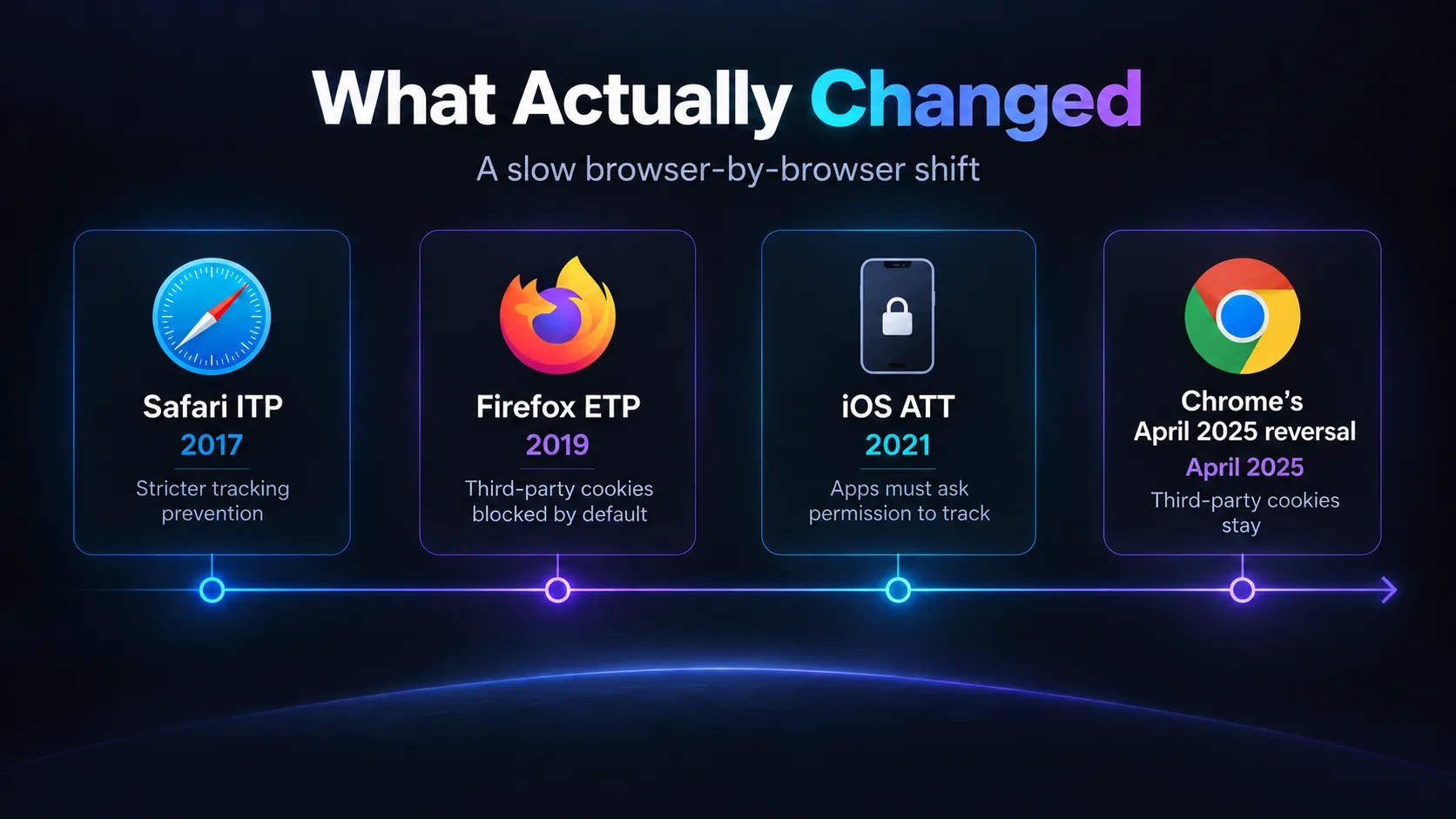
So the honest version of "what changed" isn't a single cutoff date. It's a slow, browser-by-browser and click-by-click erosion that's been running for years and shows no sign of reversing, even with Chrome staying put.
Affiliate journeys are longer than most. A click typically passes through an ad platform, a tracking link, a landing page, a redirect to the offer, and sometimes a merchant's own checkout, often across two or three different domains. Every one of those hops is a place a cookie can fail to survive:
The result is missing conversions, commission disputes with networks, and, just as damaging, bad optimization signals being fed back to Meta, Google, or TikTok. If you've ever seen your tracker, your network, and your ad platform all report a different number of conversions for the same campaign, our guide on why conversions don't match across platforms walks through why that happens.
Cookie-based tracking asks the browser to remember something and hope it's still there later. A pixel fires, a cookie gets set on the visitor's device, and when they convert, that cookie is what ties the sale back to the original click.
Every step in that chain, the browser, the device, and the time elapsed, is a place the connection can quietly break.
Cookieless tracking removes the browser as the thing doing the remembering. A postback has the network's server tell your server directly that a conversion happened.
A Conversion API has your server tell the ad platform's server the same thing. A click ID travels inside the URL, which no privacy setting can delete mid-journey. Nothing has to survive in someone's browser for days or weeks waiting to be read back later.
The practical effect for affiliate marketers is fewer disputed commissions, ad platforms that optimize toward what actually converted instead of a partial picture, and reporting you can trust enough to make budget decisions on.
It doesn't require abandoning cookies entirely, first-party cookies still have a role, but it does mean not depending on one as your only source of truth.
There's no single fix. Serious affiliate marketers typically run two or three of the following in parallel, depending on the offer and traffic source.
| Method | How It Works | Best For |
|---|---|---|
| Server-to-server (S2S) postbacks | Conversion data passes directly from the network or merchant's server to your tracker, no browser involved | Affiliate offers, CPA networks, apps |
| Server-side Conversion APIs | Sends conversion events straight to Meta, Google, or TikTok's servers instead of relying on a browser pixel | Feeding accurate signals back to ad platforms |
| Direct linking with click IDs | A unique click ID travels in the URL itself, rather than in a cookie, all the way to the offer | Offers with no landing page in between |
| First-party tracking domains | Tracking runs on a domain or subdomain you control, so any cookies set are first-party, not third-party | Extending cookie lifespan under ITP |
Instead of a cookie confirming the conversion, the network or merchant's server calls your tracker's server directly the moment a sale or lead is approved. Because there's no browser in the chain, it can't be blocked by ITP, ad blockers, or a cleared cookie jar.
This is the closest thing affiliate marketing has to a default cookieless method, and it's covered in more detail in our postback tracking guide for affiliates and our beginner's guide to postback URLs.
A Conversion API sends the same event a pixel would have sent, but from your server to the ad platform's server, bypassing the browser entirely. This matters most when you're running paid traffic to an affiliate offer and still want Meta, Google, or TikTok to optimize toward real conversions instead of a partial, browser-only picture.
Our complete guide to CAPI tracking breaks down how this works platform by platform.
When there's no landing page between the ad and the offer, a click ID (like a GCLID or an affiliate network's own click reference) travels with the URL itself rather than sitting in a cookie. It survives the trip because it's part of the link, not something a browser can quietly expire.
If you're running offers this way, our guides on direct linking and GCLID cover the setup in more detail.
Running your tracking links on a domain or subdomain you own, rather than a shared third-party domain, means any cookies your tracker does set are treated as first-party. ITP still limits how long script-set, first-party cookies last, but it's a meaningfully longer window than a third-party cookie gets, and it's a low-effort addition on top of postbacks and CAPI rather than a replacement for either.
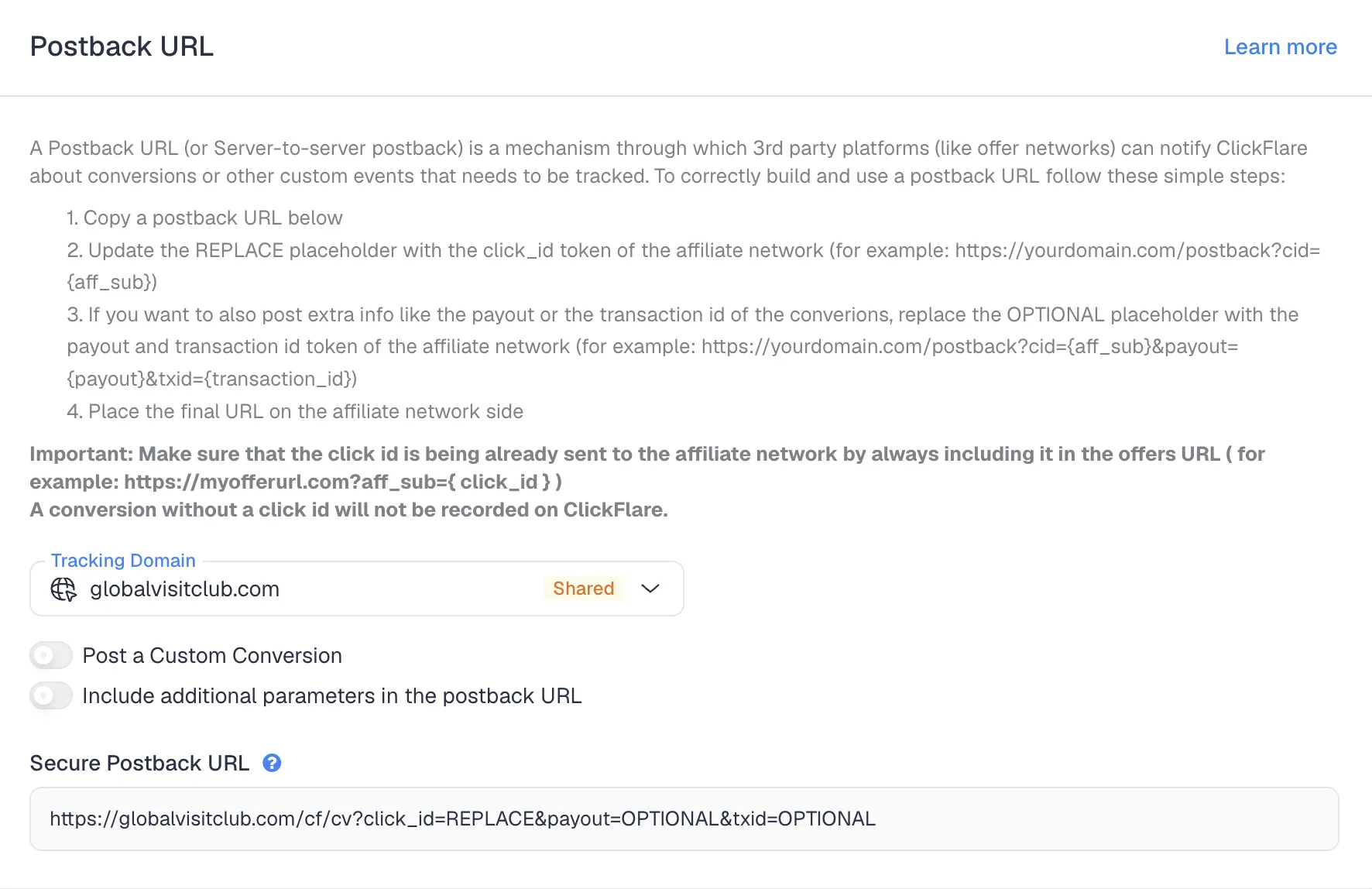
ClickFlare matches everything to a Click ID rather than a cookie, and its recommended, default conversion tracking method, S2S postback, never touches the browser at all. Every visit gets a Click ID, that ID travels with the click to the offer, and when a conversion happens, the network or merchant sends it straight back to ClickFlare's server.
Ad blockers, blocked cookies, and expired cookie lifespans have no effect on that exchange, because a browser cookie is never part of it. ClickFlare has built ready-made S2S postback templates for 100+ affiliate networks, including Everflow, Digistore24, MaxBounty, and ClickBank, plus API-based pull integrations for platforms it connects to directly, so most setups don't rely on a browser pixel at all.
Where a network genuinely doesn't support postbacks, ClickFlare falls back to a browser-side pixel or a thank-you-page script. Both of those do depend on the visitor's browser holding onto a cookie, and it's worth being upfront about that: it's the exception, not the default.
ClickFlare's own documentation on how conversion tracking works is direct about this, recommending postback specifically because it isn't affected by blocked or missing cookies.
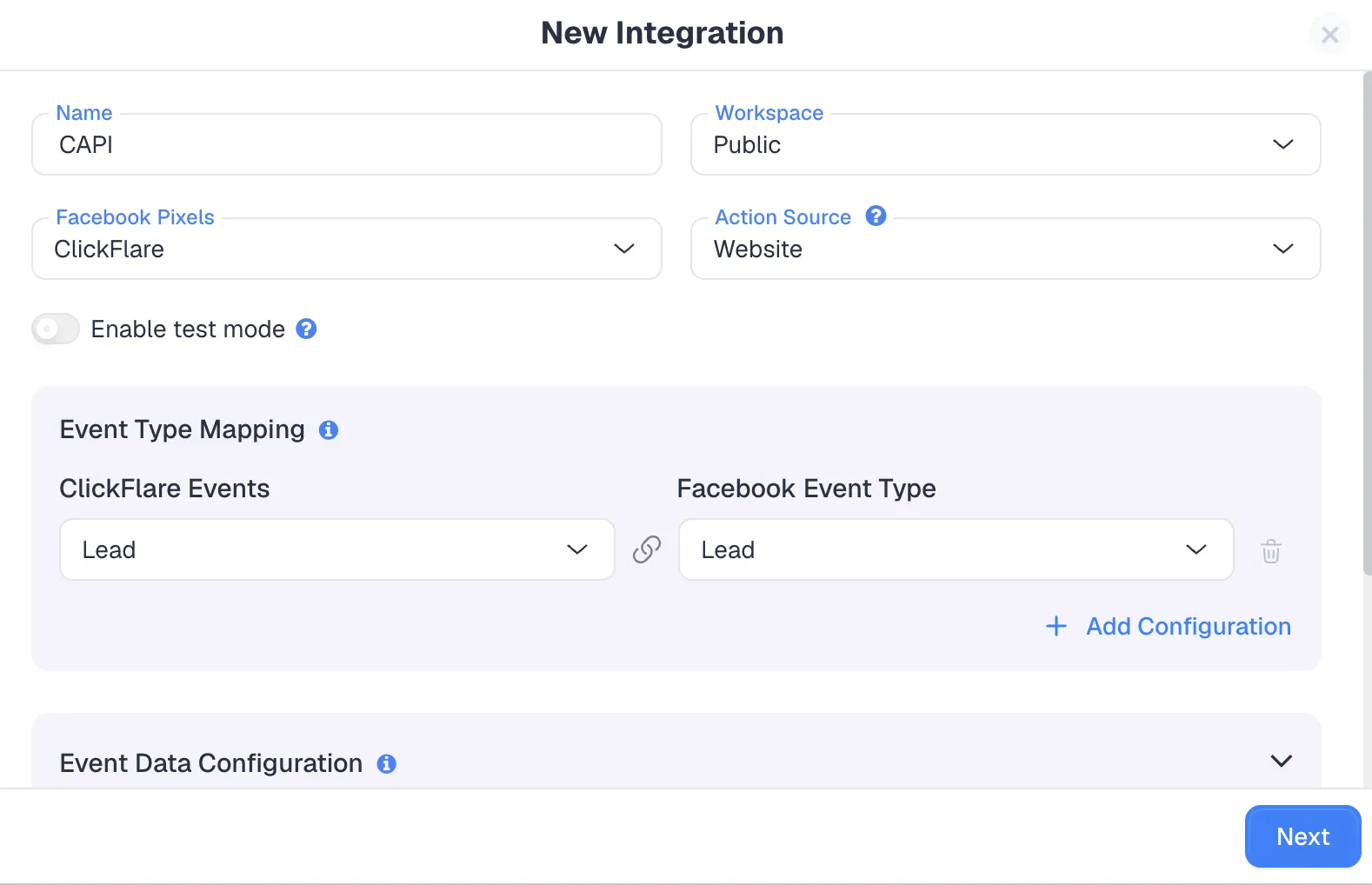
The other half of the picture is outbound, and it's easy to mix up with the tracking itself. Once ClickFlare has recorded a conversion, whether through a postback, a pixel, or an integration, its Conversion API integrations for Meta, TikTok, Google Ads, Snapchat, Reddit, Pinterest, LinkedIn, Microsoft Bing, and SmartNews send that same event, server to server, out to each ad platform.
CAPI doesn't tell ClickFlare a conversion happened; it's how ClickFlare tells the ad platform, so Meta or Google's own optimization also runs on complete, cookieless data instead of whatever a browser pixel managed to catch on their end. Put together, S2S postbacks capture the conversion without a cookie, and CAPI reports it back out without one either.
A practical rollout usually looks like this:
Cookieless tracking, for affiliate marketers, isn't a future event tied to a Chrome deadline. It's the current reality created by Safari, Firefox, ad blockers, and consent rejection, and it's been quietly costing conversions for years.
The fix isn't one tool or one setting: it's combining server-to-server postbacks, server-side Conversion APIs, and click-ID-based direct linking so your commissions and your ad platform data hold up no matter which browser or device the click came from.
Cookieless tracking connects a click to a conversion without relying on a browser cookie, using methods like server-to-server postbacks, server-side Conversion APIs, and click IDs passed through the URL instead.
No. Google reversed course in April 2025 and confirmed Chrome will keep supporting third-party cookies, and it shut down the Privacy Sandbox APIs that were meant to replace them by October 2025.
Most CPA and affiliate networks support server-to-server postback tracking, which is the most common cookieless method in affiliate marketing and typically just requires pasting a postback URL into the network's settings.
Postback tracking is one specific cookieless method. Cookieless tracking is the broader category that also includes server-side Conversion APIs and click-ID-based direct linking.
Not strictly, but a dedicated tracker makes it far easier to manage postbacks, Conversion APIs, and click IDs from one place instead of configuring each network and ad platform separately.
No. A Conversion API is outbound: it sends a conversion your tracker has already recorded out to an ad platform like Meta or Google. The conversion itself still has to be captured first, usually through an S2S postback.
Need a hand with cookieless tracking?
Try out ClickFlare for free and book a call with one of our tracking specialists who will guide you through the entire process.