Black Friday came early. Early-access prices until Nov 8.Black Friday: early-access prices until Nov 8.Early-access price ends in0d00h00m00sClaim the deal



If you are shopping for an ad tracker in 2026, the ClickFlare vs Voluum decision usually comes down to one question: how much are you willing to pay to track your campaigns accurately? Both are cloud-based trackers built for media buyers, affiliates, and agencies, and both handle clicks, conversions, and cost data across your traffic sources. The difference shows up on the invoice. Voluum locks its most important accuracy feature, the server-side Conversion API, behind a $1,999 per month plan, while ClickFlare includes full CAPI on every plan starting at $89.
This guide breaks down ClickFlare vs Voluum across pricing, tracking accuracy, speed, automation, and AI, so you can see exactly where each tracker fits and which one gives you more for your money.
Quick Summary
Voluum is a mature, feature-rich tracker with a long track record and strong built-in automation. ClickFlare is a newer platform built around one clear promise: give media buyers the same enterprise-grade tracking, including full server-side CAPI, without the enterprise price tag.
For most performance marketers, the deciding factor is value. ClickFlare delivers accurate server-side tracking, faster redirects, and higher campaign limits at a fraction of what Voluum charges to unlock the same core capabilities. Voluum still appeals to teams that want mature, rules-based automation baked into the tracker itself, though even that gap closes once you pair ClickFlare with TheOptimizer. The rest of this comparison shows where each tool wins.
Here is how the two trackers line up on the points media buyers ask about most. Below the table, we break down the seven differences that matter most, in order.
| Feature | ClickFlare | Voluum |
|---|---|---|
| Starting price | $89/mo | $149/mo |
| Active campaigns (entry plan) | 500 | 20 |
| Redirect speed | Fastest tested, ~69ms average | ~482ms average (independent test) |
| Full Conversion API (CAPI) | Included on every plan, from $89 | From the $1,999/mo tier |
| Rule-based automation | Via TheOptimizer (native integration, unlimited rules) | Built-in Automizer (capped rules) |
| Built-in AI | AI Copilot (answers questions and takes actions on your data) | Traffic-distribution AI |
| MCP access | Supported | Add-on, $119/mo |
| Pricing model | Flat, no percentage of ad spend | Tiered, with overage fees |
Pricing is where the ClickFlare vs Voluum gap is widest, and it is the main reason media buyers switch. Both trackers use tiered monthly plans, but they package their features very differently.
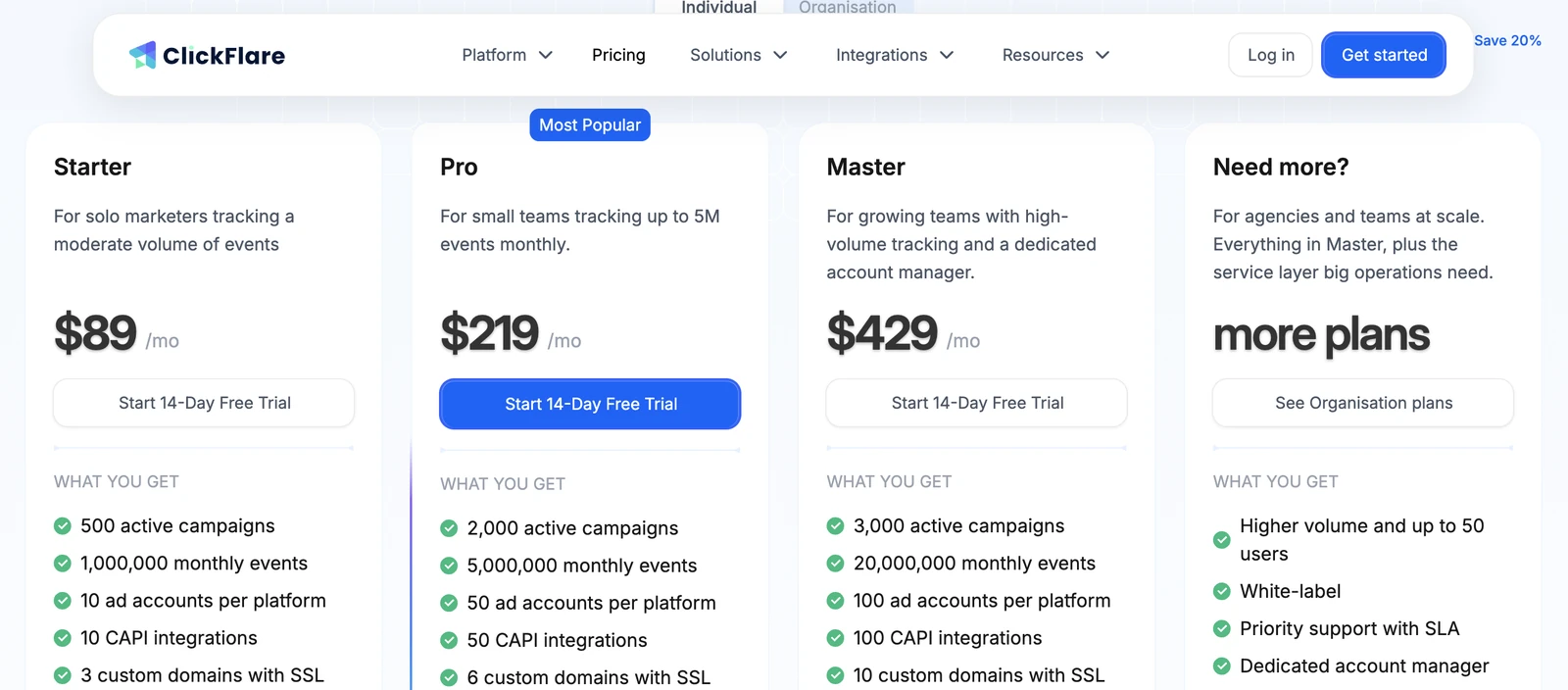
ClickFlare puts the entire tracking stack, including full server-side CAPI, the AI Copilot, automatic cost sync, and the Tag Manager, on every plan from Starter up. Voluum takes the opposite approach, gating its most valuable accuracy feature behind its top plan. The table below compares comparable tiers.
| Plan level | ClickFlare | Voluum |
|---|---|---|
| Entry plan | $89/mo, 500 campaigns, 1M events, full CAPI | $149/mo, 20 campaigns, 1M events, no CAPI |
| Mid tier | $429/mo Master, 3,000 campaigns, 20M events, full CAPI | ~$599/mo, 100 campaigns, 20M events, no CAPI |
| Where full CAPI starts | $89/mo | $1,999/mo |
| Billing model | Flat tiers, never a percentage of ad spend, bill stays flat above $1M spend | Tiered plans with overage fees as you scale |
The pattern is consistent across every tier: ClickFlare gives you more campaigns and events per dollar, and it does not make you reach a four-figure plan to send accurate server-side data back to your ad platforms. On Voluum, that same $1,999/mo tier is also where longer data retention, such as 24-month history, kicks in. For a fuller breakdown of Voluum's plans and add-ons, see our Voluum pricing guide.
Accurate tracking is the entire point of a tracker, and in 2026 accuracy depends heavily on server-side data. Browser restrictions, ad blockers, and privacy updates like iOS App Tracking Transparency have quietly eroded how much a browser pixel can actually see. The fix is the Conversion API, which sends conversion events server-to-server directly to platforms like Meta, Google, and TikTok, bypassing the browser entirely.
This is the sharpest line in the ClickFlare vs Voluum comparison. ClickFlare includes full CAPI on every plan, at an 85% average match rate, with conditional CAPI for every major source. On Voluum, the Conversion API is not part of the first four plans and only unlocks at $1,999/mo. If you are on a lower Voluum plan, you are effectively running pixel-only tracking, which loses conversions exactly where it hurts most: on the platforms optimizing your spend.
Pixels are still table stakes, and both tools use them. The difference is the accuracy layer on top. If you want a plain-English explainer, our guide on what CAPI tracking is covers how server-side events close the gaps a pixel leaves behind. You can also read Meta's own Conversions API documentation for the platform-side detail.
Headroom is an underrated difference between ClickFlare and Voluum. Voluum's entry plan caps you at 20 active campaigns, which is easy to hit the moment you start split-testing offers, angles, and sources. ClickFlare's Starter plan begins at 500 active campaigns and scales to 3,000 on Master and higher beyond that, so you are never rationing campaigns or forced to upgrade in the middle of a scaling cycle.
Event volume follows the same pattern. ClickFlare bundles generous monthly event limits at each tier, while Voluum pairs its tighter campaign caps with overage fees once you cross the line. If you are actively scaling, that 20-campaign wall is the kind of limit that quietly pushes you onto a pricier plan sooner than you planned.

For a redirect-based tracker, speed and uptime are not vanity metrics. Every millisecond of redirect delay costs you clicks, and every minute of downtime turns live campaigns into dead links that still bill you for traffic.
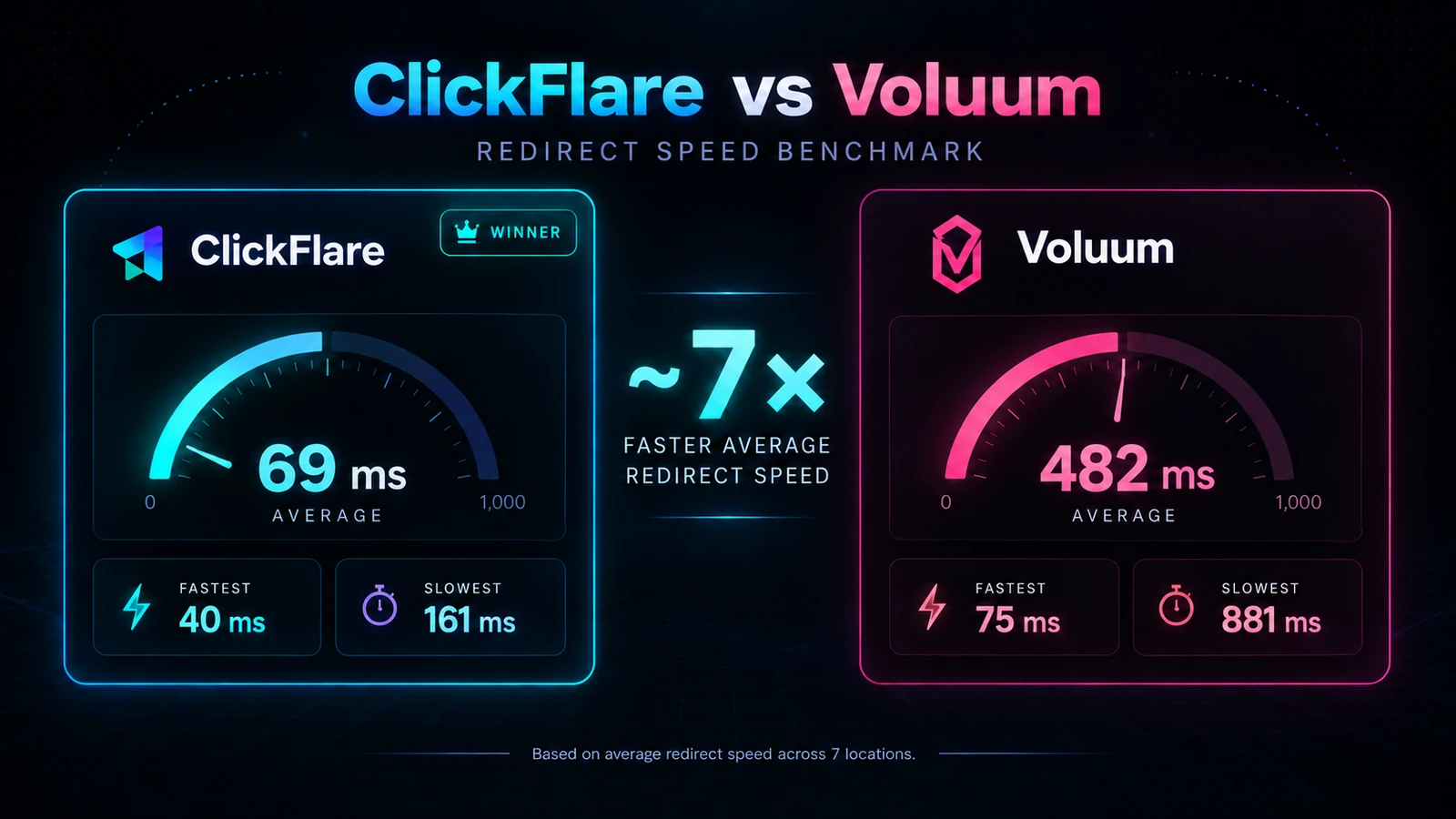
ClickFlare advertises sub-50ms redirects, and independent testing backs that up. A 2025 benchmark that measured redirect speed across seven global locations, from San Francisco to Mumbai to Sydney, found ClickFlare to be the fastest tracker in the group, with an average of roughly 69ms and sub-50ms times in several regions. Voluum averaged around 482ms in the same test, one of the slower results. You can review the full redirect speed benchmark data for yourself.
Reliability tells the same story. ClickFlare has maintained 99.99% uptime since January 2021, which is more than 2,000 consecutive days without an outage. That track record is a common reason buyers move over, usually after a tracker outage has already cost them real money. Both latency and downtime compound at scale, so the gap matters most exactly when you are pushing your highest click volumes.
Here is where we will be straight with you, because it is the one area where Voluum has a built-in edge. Voluum includes Automizer, a rules engine that lets you automate actions inside the tracker, such as pausing a campaign when ROI drops below zero. ClickFlare does not have an in-platform automation rules engine.
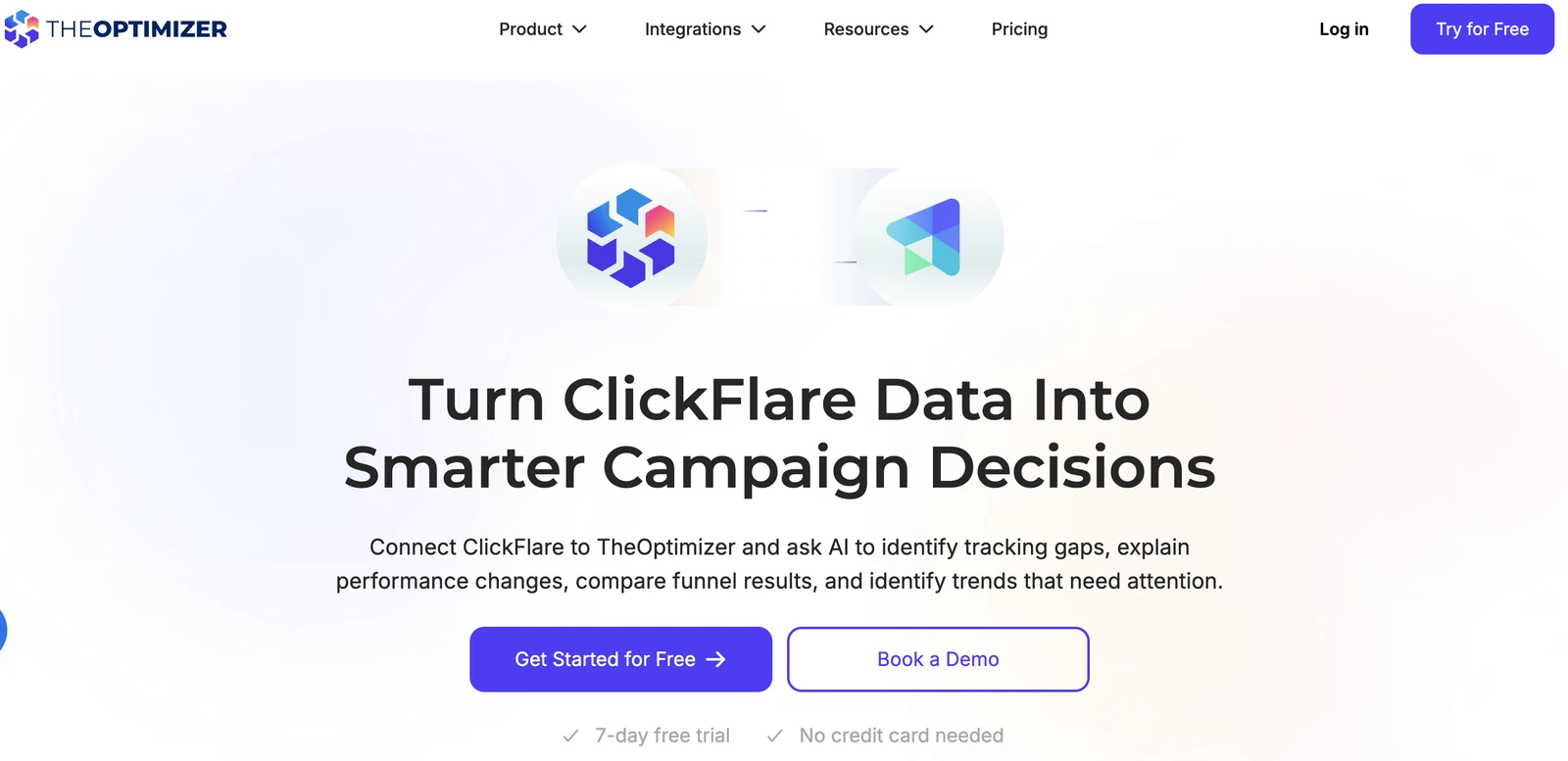
What ClickFlare has instead is a family connection. ClickFlare and the automation platform TheOptimizer come from the same parent company, and the two are natively integrated, so connecting them takes a few clicks. TheOptimizer is a dedicated automation layer that pauses losers, scales winners, and adjusts bids and budgets across Meta, TikTok, Google, and native networks, with unlimited rules rather than the capped rule counts Voluum imposes.
The interesting part is the math. Even after adding a best-in-class automation tool, the ClickFlare plus TheOptimizer stack costs far less than the Voluum tier where full CAPI even begins.
| Setup | Monthly cost | What you get |
|---|---|---|
| ClickFlare Starter + TheOptimizer Starter | From $288/mo ($228/mo billed annually) | Full CAPI tracking plus unlimited automation rules |
| ClickFlare Master + TheOptimizer Pro | From $828/mo | High-volume tracking plus advanced cross-network automation |
| Voluum (full CAPI tier) | From $1,999/mo | Full CAPI plus built-in Automizer (capped rules) |
In other words, the honest answer to the automation question is that Voluum wins on built-in convenience, but the ClickFlare plus TheOptimizer combination wins on both capability and cost. You can confirm the numbers on the TheOptimizer pricing page. If you are weighing several tools at once, our roundup of the best ad tracking software in 2026 puts this trade-off in wider context.
Both trackers use the word AI, but they mean different things by it. Voluum's AI is largely traffic-distribution AI, steering traffic toward better-performing paths. ClickFlare's AI Copilot is an analysis assistant: you ask a question in plain language, such as which sources are losing money this week, and it answers from your live tracking data and builds the report you need. For a closer look at what that unlocks, our guide on 7 ways to use AI ad tracking software walks through practical ways to put ClickFlare's AI to work.
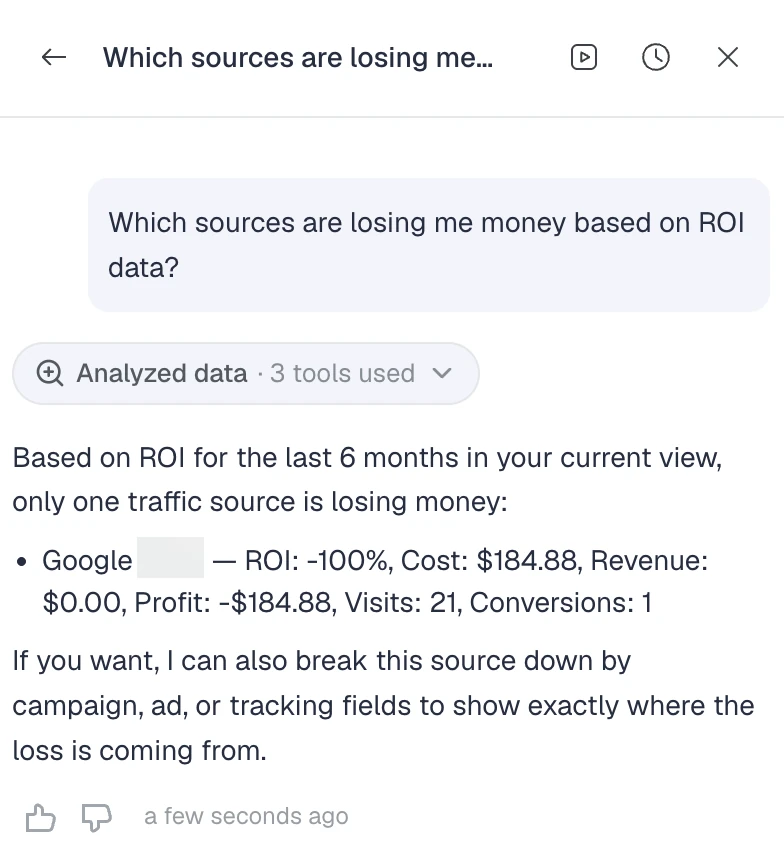
There is also the newer question of MCP, the protocol that lets you connect your tracker to an external AI tool like Claude or ChatGPT. ClickFlare supports MCP so you can pull your data into whatever AI workflow you already use. Voluum offers MCP access too, but as a paid add-on at $119/mo, which is one more line item on top of an already higher base price.
A tracker is only as useful as the stack it plugs into, so integration breadth matters in the ClickFlare vs Voluum decision. Both platforms connect with the major ad networks and affiliate platforms performance marketers rely on, and both pull cost data in from your traffic sources.
ClickFlare ships with conditional CAPI for every major source, more than 200 affiliate network integrations out of the box, and automatic cost sync that pulls ad spend from your traffic sources without manual CSV uploads. Voluum also maintains a broad set of ad and revenue platform integrations built up over years in the market. In practice, most media buyers find their existing sources supported on either tracker, so the deciding factors usually come back to price, accuracy, and speed rather than raw integration count.
The most common reason people stay on a tracker they have outgrown is the fear of moving. ClickFlare removes that friction with free, done-for-you migration. Their team maps your existing Voluum setup, rebuilds every campaign, source, and integration, and lets you run both trackers in parallel until the numbers match, so you cut over with zero downtime and no lost data.
Support is a genuine strength here, not an afterthought. Every ClickFlare plan includes two free setup calls to get your account configured correctly, plus live chat that stays included indefinitely, with no trial window that expires. Just as important, that chat is staffed by real people with deep technical knowledge of tracking and the product, so when a postback or a CAPI setup needs a second pair of eyes, you are talking to someone who genuinely understands tracking, not a bot or an outsourced ticket queue.

Most teams are fully live within 24 hours, and complex CAPI or multi-source setups are handled at no extra cost. If you have been putting off a switch because of the setup work, this is the part that usually turns out to be far easier than expected. For a wider list of options beyond this head-to-head, our guide to the best Voluum alternatives compares five trackers side by side.
Neither tracker is wrong, but they suit different priorities. Here is the simple way to decide.
Weighing ClickFlare vs Voluum, ClickFlare is the stronger choice for the majority of media buyers, affiliates, and agencies in 2026. It includes the full Conversion API on every plan, tracks far more campaigns per dollar, redirects faster, and has not gone down since January 2021, all while keeping pricing flat and transparent. Voluum remains a capable, mature platform with genuinely useful built-in automation, but you pay a steep premium to reach the accuracy features ClickFlare gives you at $89. Add TheOptimizer for automation and the value gap only widens. If tracking accuracy and cost efficiency are what you care about most, ClickFlare wins this comparison.
For most media buyers, yes. ClickFlare includes full server-side CAPI on every plan from $89, redirects faster, and allows far more campaigns per dollar. Voluum offers stronger built-in automation, but reserves full CAPI for its $1,999/mo tier.
Yes. ClickFlare starts at $89/mo versus Voluum's $149/mo, and includes full CAPI that Voluum only unlocks at $1,999/mo. ClickFlare also uses flat pricing with no percentage of ad spend, so your bill stays predictable as you scale.
Not built in. Voluum has its Automizer rules engine inside the tracker. ClickFlare instead integrates natively with TheOptimizer, a sister platform offering unlimited automation rules across ad networks, usually at a lower combined cost than Voluum.
Only on its top plan. Voluum's Conversion API is not part of its first four plans and starts at $1,999/mo. ClickFlare includes full CAPI on every plan, beginning with the $89 Starter, at an 85% average match rate.
Yes, for free. ClickFlare's team rebuilds your campaigns, sources, and integrations, and you run both trackers in parallel until the data matches. Most accounts are fully live within 24 hours, with zero downtime and no historical data lost.
Need a hand switching from Voluum?
Try ClickFlare free and book a call with one of our tracking specialists, who will handle your migration and get you live, usually within 24 hours.