


Google just announced a new RSOC policy update that will limit important Adsense for Search features depending on your account status.
These changes will take place starting from August 25, 2025, and they will majorly impact anyone in the RSOC space. Essentially, your ability to scale and monetize with RSOC depends entirely on your account status.
If you have access to AdSense for Search and your account remains compliant, you could receive an invitation from your Google AdSense account manager to enable these crucial features, referred to as Restricted Access Features (RAFs).
Currently, you can only enable these features via an invite. When this new RSOC policy update launches, you will see your account status directly in AdSense.
If you believe you are eligible but have not received an invitation yet, or you have any questions about your status, you could try requesting access through your AdSense account manager.
What exactly are these Restricted Access Features, and why should you care?
As explained above, Restricted Access Features, or RAFs, are powerful RSOC features that are crucial for optimization and scaling.
With RSOC gaining more traction in 2025, Google introduced this new RSOC policy update in order to enforce higher compliance standards and only allow trusted publishers to scale.
These features give you control over related search styling, they allow you to serve your own search terms, give you access to advanced reporting channels, amongst other things.
Let’s take a closer look at what these features actually are.
The new RAFs impact different parts of RSOC, including the Related Search unit functionality, style customizations, and reporting features.
Regarding the Related Search unit functionality, the RAFs include:
Regarding the Related Search unit style, with RAFs you can:
In terms of tracking and reporting, this new RSOC policy update allows you to:
If you want to learn more about how RSOC tracking works in 2025 we have a full guide on that topic. Please note that RAFs are still new, and Google may add, remove or change RAFs later on.
This new RSOC policy update affects everyone in the RSOC space, whether you use AdSense for Search directly or through third-party feed providers. Even if you are running RSOC through a feed provider, such as Ads.com or Sedo, you (as the account owner) are still responsible for being compliant.
ClickFlare and TheOptimizer are actively working with search feed providers to help improve compliance (e.g., increased transparency, keyword handling, etc) under the new RSOC policy update.
For anyone doing RSOC, it is important to be extra cautious regarding RSOC compliance starting from now. In the sections below, we will explain in more detail how this system works and which behaviors you need to avoid.
To determine who gets access to RAFs, Google has come up with a Strike System. Let’s take a closer look at how each strike affects your status.
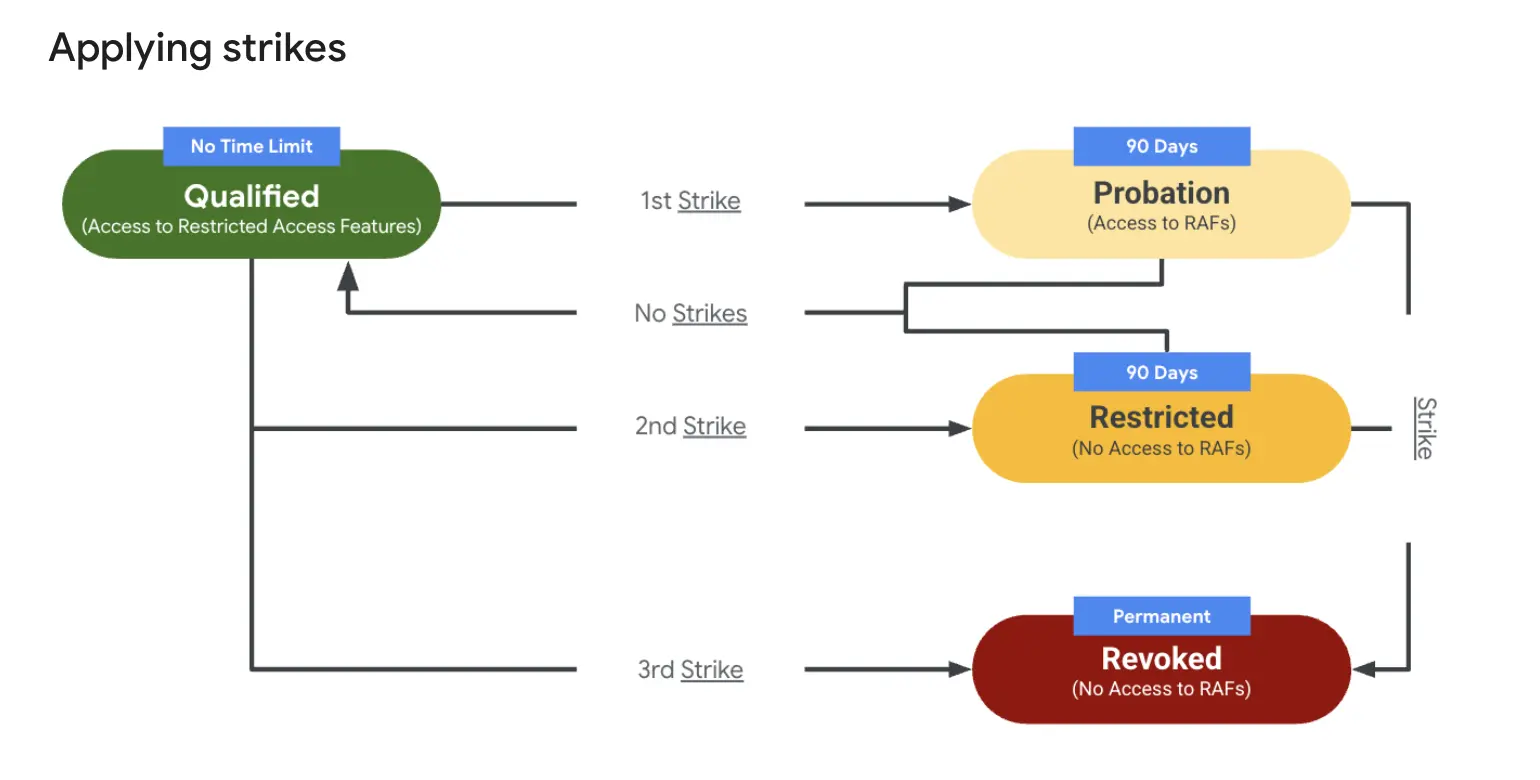
Once you have accepted Google’s invite for the new RAFs system, your account status will be shown as “Qualified”.
If you get the first strike, you will be placed on “Probation” for 90 days. You will still get access to RAFs at this stage, but if you commit another strike during the 90-day probation period, your account will move immediately to “Revoked”. This means you will lose access to RAFs permanently.
If you remain compliant throughout the 90-day period, your account will be reset to “Qualified”.
If you receive the second strike within a two-year period, your account status will change to “Restricted” for 90 days. This means that you won’t get access to RAFs throughout this period.
If you get another strike before the 90 days are over, your status will immediately change to “Revoked”, and you will lose access to RAFs permanently.
If no other strikes happen during this time, you will be moved to the default “Qualified” again.
Logically, if you receive your third strike within a two-year period, your status will be set to “Revoked” and you will lose access to RAFs permanently.
We discussed Google’s Strike System at length so far, but what types of policy violations actually contribute to strikes?
There are two ways to get a strike:
Let’s take a look at several examples:
Since the RSOC policy update will only go into effect starting from August 25, 2025, you still have some time to fix and appeal policy violations before they affect your RAFs status.
However, if on August 25 your account is still violating policies from past activities, you risk getting a strike right away.
A common question is, “Can you remove strikes and reset your account status?”. The only way to remove strikes at the moment is to not commit any further strikes within the two-year period. After the two years, all strikes are removed.
However, if your account has already been “Revoked”, you cannot remove your strikes.
The short answer is, no. You cannot appeal a strike directly, but you can appeal the policy violations that led to your strike. You can appeal via the Policy center. Note that at the moment, account managers cannot appeal on your behalf.
If it turns out that there was no actual policy violation, the strike will be removed.
However, if the appeal concludes that there was a policy violation (even if it was later fixed), the strike will remain.
Losing RAF access means that you cannot properly optimize and scale your RSOC operation any longer.
As explained in previous sections, if your account has been “Revoked”, you will lose access to RAFs permanently. You cannot re-apply for a new AdSense account.
You can still run RSOC, but your features will be extremely limited. For example:
All these limitations mean that your pages will be generic, you cannot optimize the content or design to increase clicks, and it will be harder to track performance with accuracy.
Starting from August 25, 2025, there will be major shifts in the RSOC space following Google’s latest RSOC policy update.
With the introduction of Restricted Access Features (RAFs) and Google’s Strike System, your ability to scale, track, and optimize RSOC pages will fully depend on your compliance and account status.
Having access to RAFs can make or break your success with RSOC, so it is crucial that you maintain a compliant account.
The key step you can take right now is to ensure that you appeal and fix any outstanding issues before August 25. After August 25, make sure your traffic sources are always compliant, keywords are transparent and in line with the content of the page, ad creative tracking is accurate, and the pages are not misleading in any way.