


Voluum is a cloud-based tracking platform for performance marketers, offering campaign tracking, reporting, and automation tools. Voluum pricing in 2026 ranges from lower-tier plans for solo marketers to much more expensive options for agencies and larger teams.
In this article, we break down Voluum's pricing plans in 2026, outlining each plan's features and costs so that you can understand exactly what you are paying for.
Voluum offers seven different pricing plans, divided into Individual plans and Business plans. Their Profit plan starts at $149/month, and it comes with basic campaign tracking and automation features.
While all plans include these features, with the higher plans you get a higher number of campaigns and monthly events you can track, as well as several additional features.
Starting with the individual plans:
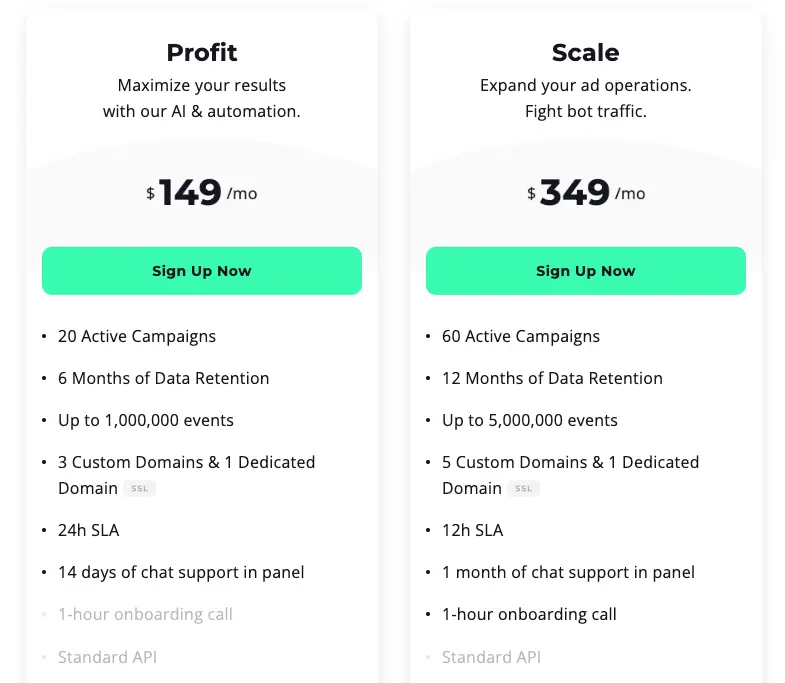
The starter plan costs $149/month and it allows users to track up to 20 campaigns and 1 million events. This is mostly for performance marketers who are just getting started and only need to track a few campaigns.
If you are spending less than $1,000 on ads per month, you also get access to 10 automation rules. You can use these rules to automatically pause or start campaigns based on performance. If you exceed this limit, you need to pay extra for all the additional ad spend.
This plan does NOT include API access, a setup call, additional users, big data reports, anti-fraud kit or AI features. That means that with this plan you cannot send first-party data back to your ad platforms, get technical help, or create detailed reports.
The Scale plan costs $349/month and it covers up to 60 campaigns and 5 million events. You also get up to 20 automation rules if you are spending less than $1,000/month in ad spend.
The Scale plan comes with several improvements and additional features compared to the Profit plan:
Although this plan has more features than the previous one, it still does NOT include API access or additional users, or support chat beyond the first month.
Now let’s move on to the business plans:
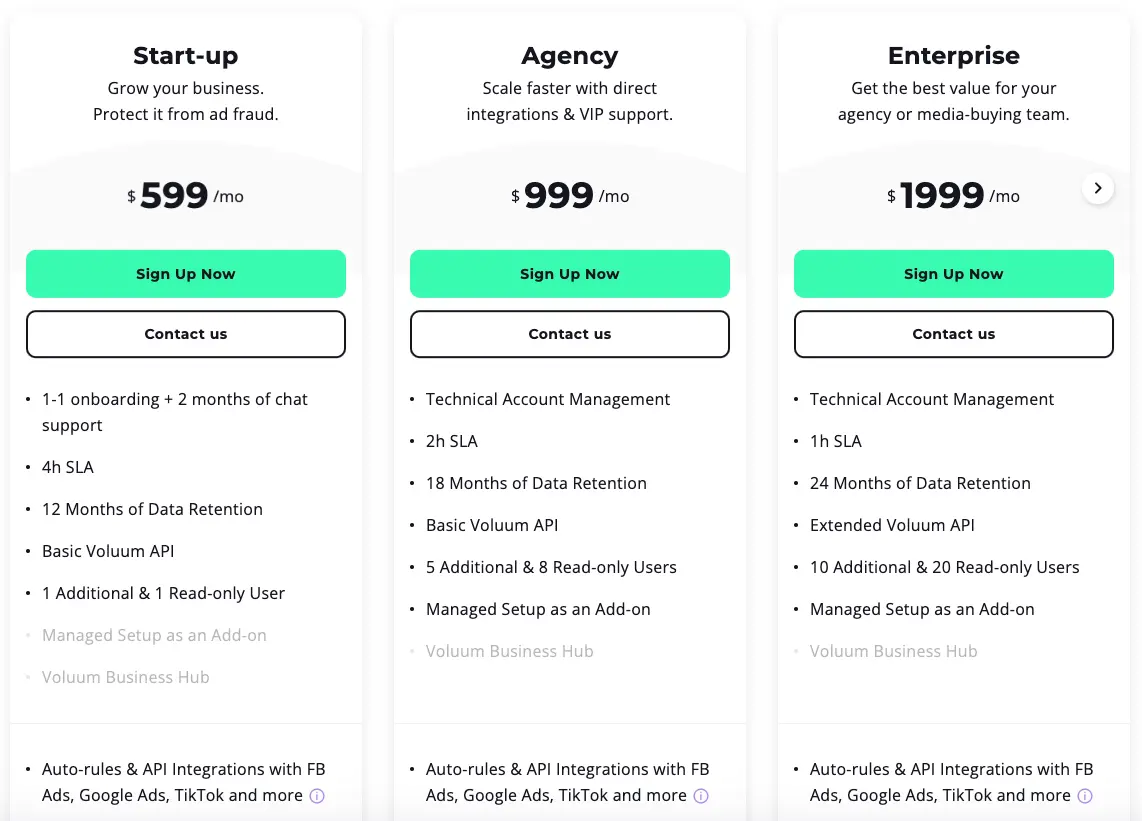
The first business plan starts at $599/month and it covers up to 100 campaigns and 10 million monthly events. If your ad spend is below $15,000/month, you can also create 30automation rules.
This plan has the same features as the Scale plan, but it includes more:
With the Start-up plan you also get access to Voluum’s basic API, but you can still NOT send data back to your ad platforms.
The Agency plan costs $999/month and it covers 25 million events as well as 200 campaigns.
One of the biggest upgrades of this plan as compared to the previous ones is the addition of an account manager. This account manager will help you with the initial setup and any questions. You can also create a group chat with them on your preferred channel.
You can also get five additional users, and 40 automation rules. With this plan, you still CANNOT send data back to your ad platforms.
The Enterprise plan is meant for larger agencies or media buying teams, and it costs $1,999/month.
It covers 60 million monthly events and 400 campaigns. This plan also comes with two additional features, the extended Voluum API and advanced Facebook integration.
The extended API allows users to do more requests per second and pull larger reports. From this plan onwards, you can also post conversion data back to your ad platforms.
The advanced Facebook integration includes ad and ad set management functionalities, as well as cost synchronization. This feature applies to the automation rules.
The final two plans are Corporate and Executive, meant for larger teams investing higher budgets on ads:
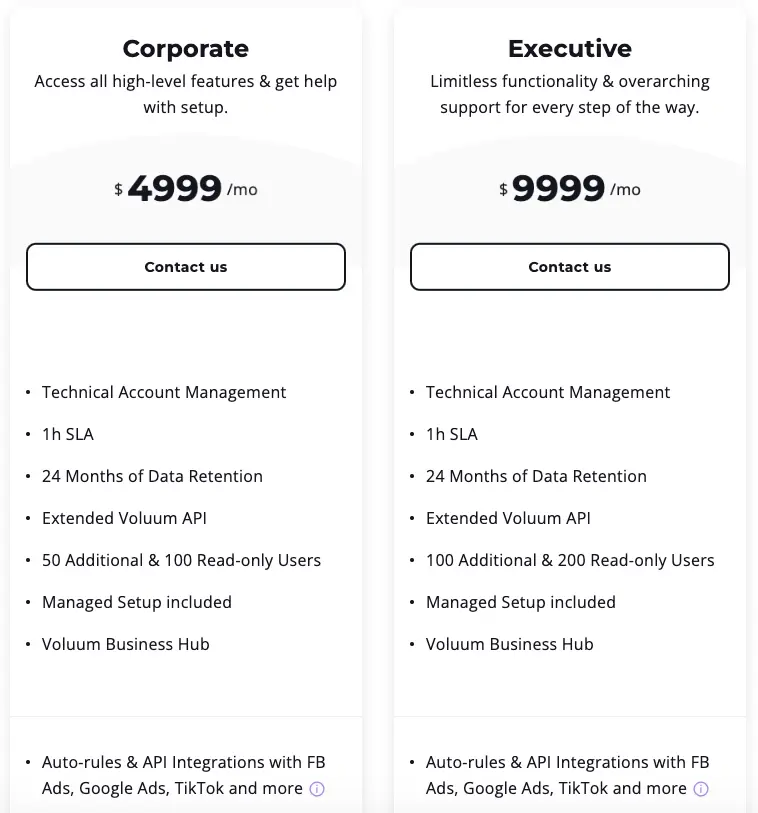
The Corporate plan is priced at $4,999/month and it covers up to 300 million events and 2,000 campaigns.
There are two new features that come with the Corporate plan. The first one, Voluum Business Hub, includes personal introductions to other companies, agencies or traffic sources by your Voluum account manager.
The second new feature allows you to integrate with data visualization tools such as Tableau, Google Looker and Microsoft Power BI.
The highest plan in Voluum is the Executive plan, and it costs $9,999/month. With this plan, you can track up to 5,000 campaigns and 700 million events.
While this plan doesn’t have any new features, it has more:
Let’s take a closer look at Voluum’s features:
Since Voluum is primarily a tracking software, let’s start by exploring their tracking features. All pricing plans include the following features:
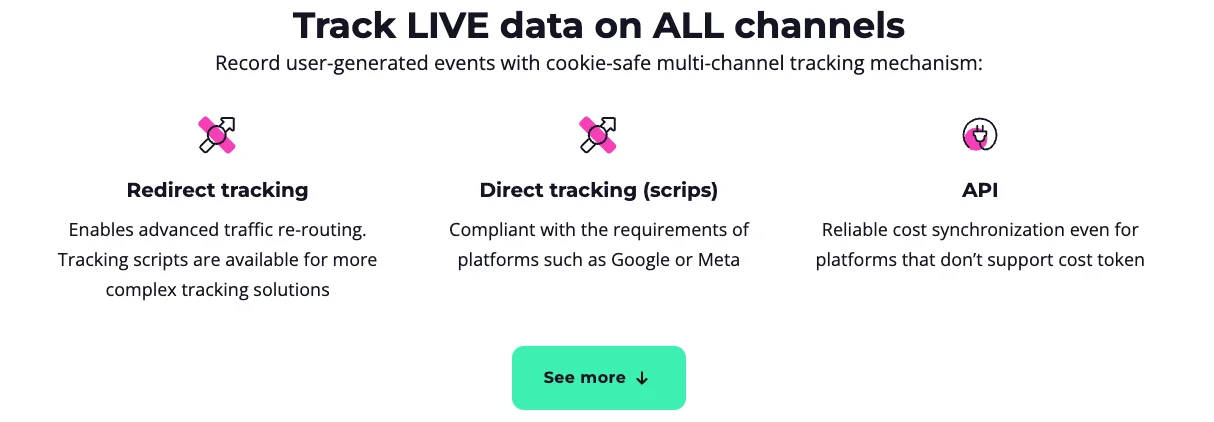
Keep in mind that each Voluum pricing plan includes a monthly event limit (visits, clicks, conversions), as well as a limit on the number of campaigns, offers, or landers you can track.
As mentioned above, attributing conversions back to your ad platforms is an important step towards optimizing your campaigns. This is only possible starting from the Enterprise plan at $1,999.
All Voluum plans include access to Automizer, which is their API tool. This includes integrations with several ad networks such as Google Ads, Meta, TikTok, Taboola, Outbrain, Bing Ads and more.
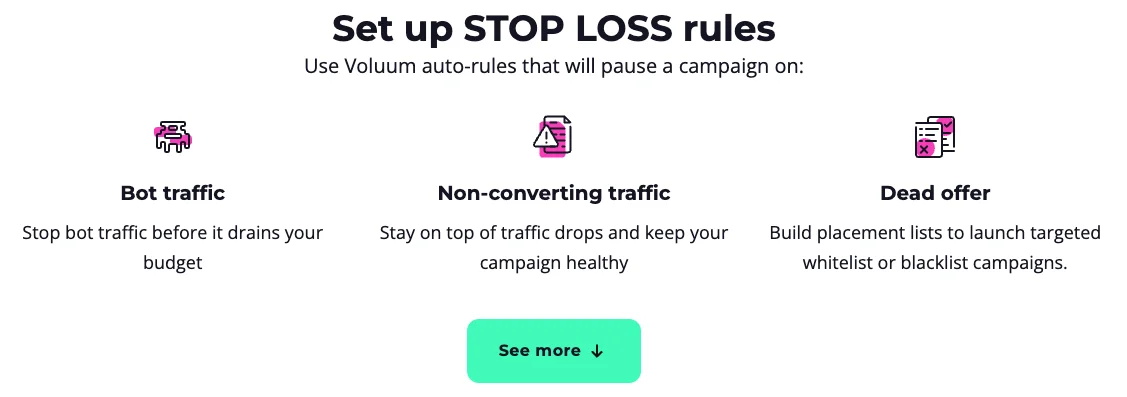
However, there are certain limitations on what you can do with the Automizer based on your pricing plan. For example, with the individual plans you can only use the Automizer for free if you are spending less than $1,000 per month on ads, and you can only create a limited amount of automation rules.
Also, anything below the Enterprise plan ($1,999/month) does not include the advanced Facebook integration which allows you to manage on an ad set or ad level.
With each Voluum plan you get access to real-time reporting. You can also apply up to 3 data groupings and drill-downs, allowing you to break down data by different dimensions such as traffic source, geo, browser, and so on.
You can add custom columns to your reports to add or remove metrics from your display, and you can apply multicurrency support if your ad and revenue accounts are in different currencies.
With the business plans, you can also get additional features such as 4-dimensional reports (where you can add 4 groupings instead of 3) and big data reports (which allow you to look at longer time ranges and share reports via email in CSV format).
The amount of users you can invite also depends on your plan. The two individual plans do not allow any additional users, so you need to pay at least $599 for the Start-up plan in order to invite an extra team member.
The multi-user feature also includes workspaces, which help in separating campaigns or projects and keep things organized for all team members. The higher the plan, the more workspaces you can create.
The support you get also depends on the plan you choose. This is an important one, because with trackers there are bound to be technical questions that you need professional help for. Here is the type of support you get for each plan:
Choosing the right Voluum plan heavily depends on the size of your operation. The key difference across all plans is the amount of monthly events and campaigns you can track, the number of users you can invite, and the amount of automation rules you can set.
The rest depends on your own “deal breakers”, for example:
Voluum works with overages, which means that if you exceed your plan limits you will need to pay additional fees.
The first overage applies to the monthly events. Each plan comes with a limit on how many events you can track. If you exceed that limit, you will need to pay an additional fee for every 1,000 events. The amount of overage fees also depends on the plan. The lower the plan, the more you will have to pay per 1,000 events. For example, the first plan covers up to 1 million events. The overage is $0.06. If you had 2 million events, you would pay:
The second overage applies to the Automizer add-on. For each plan, the Automizer covers a limited ad spend. If you exceed that ad spend, you will pay additional fees on the extra ad spend. For example, the first plan allows you to use the Automizer for up to $1,000 in ad spend. The overage is $0.01. If your ad spend was $2,000 you would pay:
Voluum offers useful features such as integrations with ad platforms, supports different types of tracking, gives real-time reports, and it has an in-platform automation tool.
The key factor you need to consider is the features included in each pricing plan. A few key features such as Conversion API, technical support or multi-user only start from the higher plans. Also, you need to consider the limitations on monthly events and ad spend. If you take all this into account, Voluum can be quite pricey.
Voluum’s biggest advantage is that you can perform tracking and automation from the same platform. Since each plan covers access to the Automizer, you can get your data and also create automation rules that help you save time in managing your campaigns.
They also offer many different pricing plans, which gives a degree of flexibility in choosing something that works for your team.
The core disadvantage is that Voluum is very pricey compared to industry standard.
The starting plan costs $149/month, and if you break it down, you cannot do much with this plan. It only allows you to track 20 campaigns, create 10 automation rules, and it does not provide any setup support. It is quite expensive for a beginner without even offering the support you will likely need at that stage.
Also, one of the biggest drawbacks is that you only get access to the Conversion API with the Enterprise plan which starts at $1,999.
Let’s do a detailed comparison between all the different features between ClickFlare and Voluum:
Let’s do a comparison between Voluum and ClickFlare pricing plans.
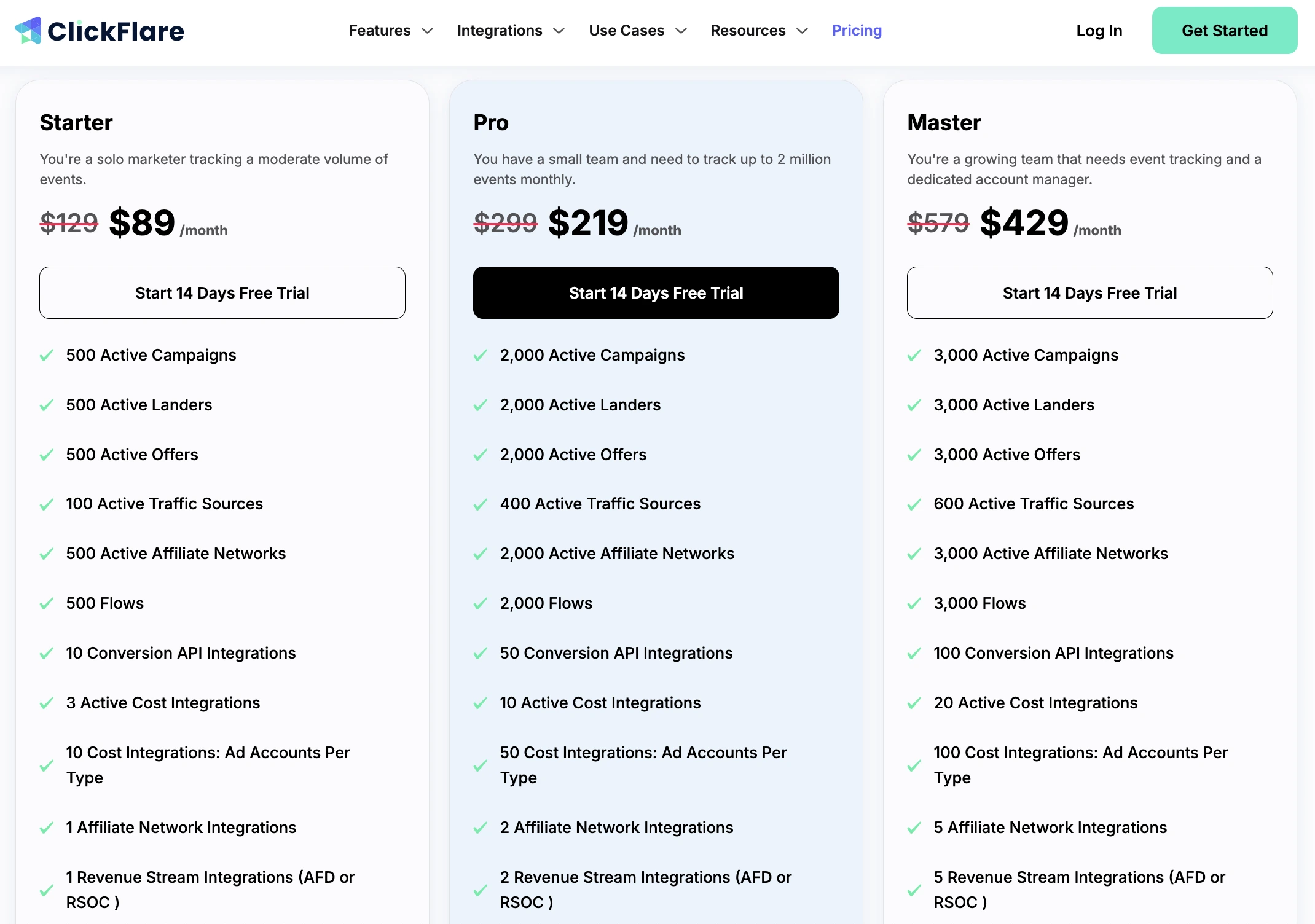
Both ClickFlare and Voluum are powerful ad trackers, and choosing between them depends on your priorities and budget.
If you're looking for better value in terms of traffic allowance, ClickFlare gives you more events and campaign capacity across all pricing plans. It also includes Conversion API integration in all plans, which helps ensure accurate tracking—something Voluum only offers from its $1,999/month plan.
Support is another aspect to consider, with ClickFlare offering setup calls and live chat from the start, while Voluum limits these features to higher plans. That said, Voluum does have an edge with its Automizer tool for campaign automation, which can be useful for advanced users managing many campaigns.
So, if automation features like rule-based campaign controls are a priority, Voluum may be more suitable. If you're looking for higher traffic limits, built-in Conversion API, and hands-on support for all pricing tiers, ClickFlare could be a better fit.
For more tracking software pricing comparisons, check out our ClickMagick pricing overview.
Voluum has seven different pricing plans, with the cheaper one starting at $149/month and the most expensive one costing $9,999/month.
Yes, Voluum offers a discount if you purchase the annual plans instead of the monthly ones. This discount is between 10-20% depending on the plan you choose.
Yes, Voluum offers a 14-day free trial.
Voluum doesn't have hidden fees, but it does charge overage fees if you go over your plan limits, for example, exceeding your monthly events or the Automizer’s ad spend cap will result in extra charges.
Voluum is priced at a premium because it’s built for high-volume advertisers.
The best alternative to Voluum depends on your specific needs, but tools like ClickFlare are often considered by users looking for more flexible pricing, higher events and campaign limits, and built-in features like Conversion API across all plans.
Voluum is an ad tracker that offers a variety of features for performance marketers, but many key tools like Conversion API access and advanced support are only available on higher pricing plans. Alternative tools like ClickFlare include more features and higher event and campaign limits across all plans.