


Most affiliates start with one simple question: how do you get paid without having to close a sale yourself? That is the appeal of CPA marketing, a model where you earn a fixed payout every time your traffic completes a specific action, like a signup, a lead, or an install. So what is CPA marketing in practice, and why do so many media buyers build their entire income around it?
This guide breaks down how CPA marketing works, the offer types you will run, the networks you will join, and how to track every conversion so you actually know which campaigns are profitable. By the end, you will know how to start and how to keep your numbers honest with a tracker like ClickFlare.
Quick summary
CPA marketing, short for cost per action (also called cost per acquisition) marketing, is a performance-based model where an advertiser pays an affiliate a fixed fee each time a referred user completes a defined action. That action might be filling out a form, signing up for a free trial, installing an app, or making a purchase.
Unlike paying for clicks or impressions, the advertiser only pays when the agreed action actually happens. That is what makes it low risk on their side and appealing on yours: you do not build the product or handle customer support, you drive targeted traffic to an offer and earn when it converts.
Payouts are agreed up front and vary by how hard the action is and which vertical you are in. A simple email submit might pay a dollar or two, while a completed sale or a qualified financial lead can pay significantly more.
At its core, CPA marketing follows the same loop every time, no matter the offer:
The tracking link is what holds the whole thing together. It carries a click ID that lets the network match a conversion back to the exact click that produced it, so everyone agrees on what you are owed.

| Player | Role |
|---|---|
| Advertiser | The brand or offer owner that wants a specific action and sets the payout for it. |
| Affiliate (publisher) | You. The person driving targeted traffic to the offer in exchange for a payout per action. |
| CPA network | The middleman that hosts offers, tracks clicks and conversions, verifies actions, and pays affiliates. |
| User | The person who clicks your link and completes (or does not complete) the action. |
CPA marketing is a type of affiliate marketing, so the two overlap. The difference is what triggers the payout.
Traditional affiliate programs, like Amazon Associates, usually pay a percentage of a sale. CPA offers pay a flat fee for a defined action, and that action often is not a purchase at all. It can be a lead, a free trial, or an app install, which tend to convert more easily than a paid sale.
| CPA Marketing | Classic Affiliate Marketing | |
|---|---|---|
| Payout trigger | A defined action (lead, install, trial, sale) | Usually a completed sale |
| Payout type | Fixed fee per action | Percentage of the sale |
| Conversion barrier | Lower, since many actions are free | Higher, since the user has to buy |
| Typical partner | A CPA network of vetted offers | A brand's own affiliate program |
Action means different things depending on the offer. These are the payment models you will see most often inside a CPA network:
| Model | You Get Paid When | Common Verticals |
|---|---|---|
| CPL (cost per lead) | A user submits their details (email or full form) | Insurance, finance, education, home services |
| CPS (cost per sale) | A user makes a purchase | Ecommerce, nutra, subscriptions |
| CPI (cost per install) | A user installs an app | Mobile apps, games, utilities |
| Trial / CPA (free-to-paid) | A user starts a free trial or signs up | Streaming, SaaS, memberships |
| CPE (cost per engagement) | A user completes a smaller step, like a PIN submit or short survey | Sweepstakes, mobile content, surveys |
As a rule, the easier the action, the lower the payout and the more volume you need. Higher payouts usually mean stricter verification and more competition for the traffic.
CPA marketing has stayed popular because the economics favor the affiliate when the tracking is clean. The main reasons:
The market backs this up. US affiliate marketing spending grew nearly 50% in three years, from $9.1 billion in 2021 to $13.62 billion in 2024, according to the Performance Marketing Association. Still, be honest with yourself about the trade-off: competition is high, and margins depend on tight optimization, so profitability comes from testing and tracking, not from the model alone.
You can go from zero to your first live campaign in a handful of steps. The order matters more than the speed.
Pick a vertical you can realistically create traffic for, whether that is finance, mobile apps, sweepstakes, or ecommerce. Staying in one lane lets you learn the audience and reuse what works across offers.
Offers live on networks, so this is where you get access. Look for networks with reliable tracking, on-time payments, and responsive affiliate managers. Our breakdown of the best affiliate networks in 2026 covers who is worth applying to and what each one is known for.
A great offer on the wrong traffic still loses money. Match the offer's payout, allowed traffic sources, and target countries to what you can actually deliver before you spend a cent.
This is the step most beginners rush, and it is the one that decides whether you ever become profitable. You need a tracker that records every click, receives conversions from the network, and ties each one back to the exact campaign and source. We cover how to do this with ClickFlare below.
No single source wins for every offer. Most affiliates test a few and double down on what converts:
ClickFlare is a tracking and attribution platform that sits between your traffic source and your offer. It records every click, attributes each conversion back to the campaign, ad, and keyword that drove it, and shows you cost and revenue side by side. It does not generate traffic or run offers, it is the measurement layer that tells you what is working.
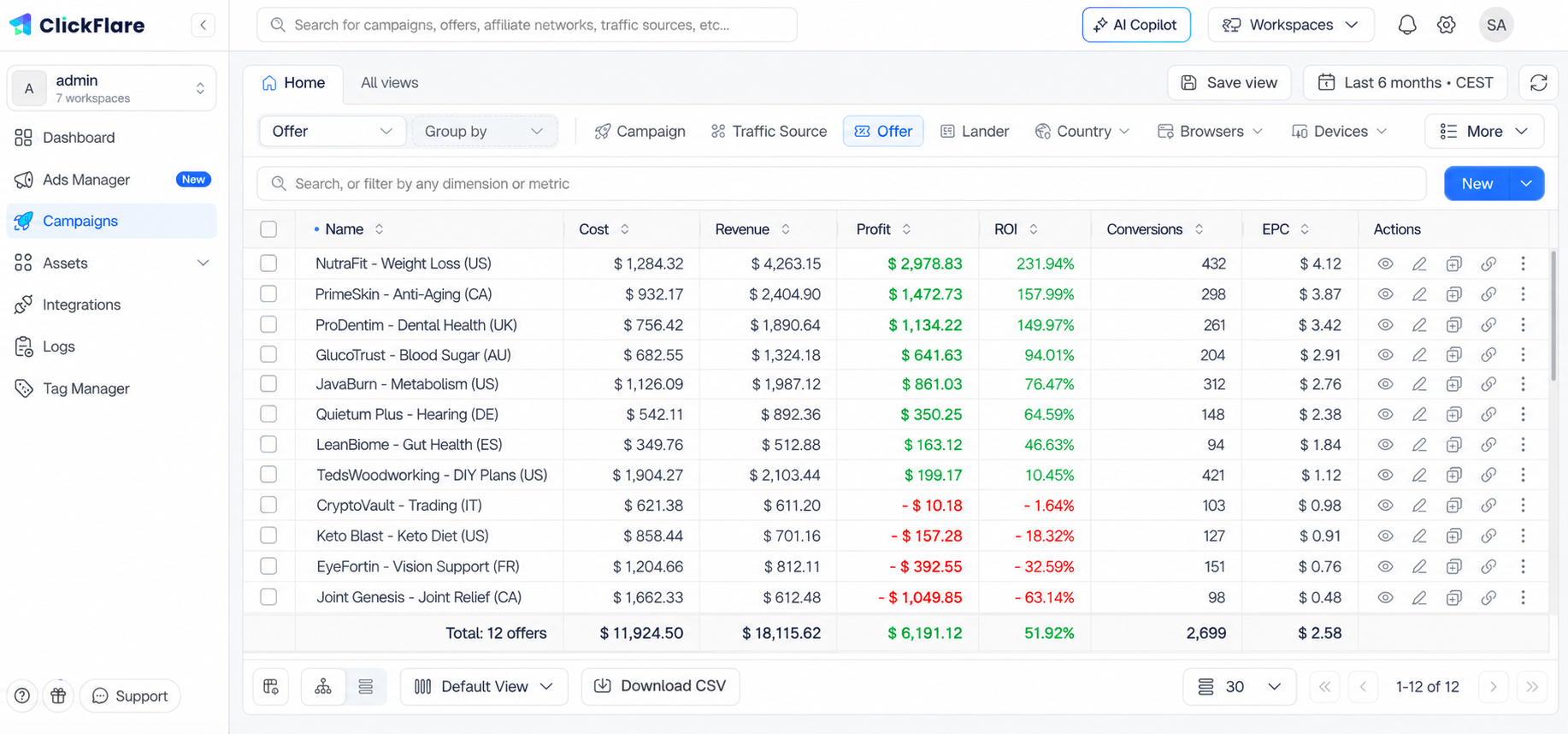
For CPA campaigns specifically, the setup is straightforward:
The payoff is clarity: profit per offer, per traffic source, and per ad, in one dashboard. That is what lets you cut the losers and scale the winners with confidence instead of guesswork.
CPA marketing is one of the most accessible ways to earn as an affiliate, because you get paid for actions rather than only for sales, and you never have to own a product. The model is simple, but the money is in the details: the right offer, a traffic source that matches it, and tracking accurate enough to tell profit from noise. Get those three right, and CPA marketing becomes a channel you can test, measure, and scale with real confidence.
CPA marketing is a model where you earn a fixed fee each time your traffic completes a specific action, such as a lead, signup, install, or sale. You promote offers from a CPA network and get paid per verified conversion, not per click.
Not quite. CPA marketing is a type of affiliate marketing. The difference is that CPA offers pay a flat fee for a defined action, which is often a lead or install, while classic affiliate programs usually pay a percentage of a completed sale.
Earnings vary widely. Payouts range from under a dollar for simple email submits to hundreds for qualified financial leads. Your income depends on offer payout, traffic quality, and how tightly you optimize, so results scale with testing, not time alone.
Yes. A CPA network only reports conversions, not your full cost picture. A tracker like ClickFlare ties each conversion back to the exact campaign and source, so you can see true profit and cut unprofitable traffic before it drains your budget.
Yes, CPA marketing is a legitimate, widely used performance model. The key is working with reputable networks, following each offer's allowed traffic rules, and staying compliant with privacy and consent requirements when you track users.
Need a hand tracking your CPA campaigns?
Try ClickFlare free and book a call with a tracking specialist who will walk you through the whole setup, from your first offer to your first profitable scale.
TRY CLICKFLARE FREE FOR 14 DAYS →