A listicle landing page is one of the highest-converting ad destinations in performance marketing, which is exactly why media buyers and affiliates keep coming back to it. Instead of hitting visitors with a hard sell, it reads like a helpful '5 reasons why' article and warms people up before sending them to an offer.
The problem is that most guides only teach you how to design one, and then go quiet the moment you ask how to actually track it. In this guide, we'll cover what a listicle landing page is, how to build one that converts, and how to track the full funnel accurately so you know which page and which angle is making you money.
Quick Summary
- A listicle landing page is a list-format landing page ('5 reasons why...') that reads like content but is built to convert cold ad traffic.
- It's a type of advertorial, used most in native ads, affiliate marketing, and ecommerce as a top-of-funnel destination.
- Build it around a specific angle, lead with your strongest point, and repeat the CTA top, middle, and bottom.
- Track the full ad → pre-lander → lander → offer funnel with ClickFlare's dedicated Listicle path type.
- The key tracking step most people miss: add the lander script to the pre-lander, not just the landers.
What Is a Listicle Landing Page?
A listicle landing page is a landing page built in a list format, usually something like '7 Reasons Shoppers Are Switching to X' or '5 Things to Know Before You Buy Y.' It blends the educational, easy-to-read feel of a blog post with the single-minded conversion focus of a sales page. It's a close cousin of the advertorial landing page, and the two terms often get used interchangeably.
The difference is mostly format: an advertorial can be written as a narrative story, while a listicle breaks the same persuasion into numbered points. Both are designed to look like content, not an ad, which is what makes them so effective as a top-of-funnel destination for cold traffic.
You'll see listicle landing pages used most often in native advertising, affiliate marketing, and ecommerce, where the goal is to educate a cold audience before asking for the sale. Why Listicle Landing Pages Work So Well
People don't read landing pages word for word. They scan. Numbered lists match that behavior perfectly, giving readers clear entry points and a sense of progress as they move down the page. According to Nielsen Norman Group research on how people read online, users scan pages in predictable patterns rather than reading every line, so content that is broken into scannable chunks holds attention far better. A listicle landing page also does three things a standard product page struggles with: - It lowers resistance. Because it reads like advice instead of an ad, cold visitors stay longer and keep an open mind.
- It handles objections in order. Each list item can tackle a different doubt, from price to quality to 'will this work for me.'
- It builds a natural path to the CTA. By the time a reader reaches the end of the list, they've already absorbed your best arguments.
This format is a staple for media buyers running native traffic. If that's your channel, our roundup of the best native advertising platforms pairs well with a strong listicle funnel. Anatomy of a High-Converting Listicle Landing Page
The best listicle landing pages tend to follow the same proven structure. You don't need every section below, but the strongest pages hit most of them in roughly this order. | Section | What It Does |
| Hook headline | Promises a benefit or a number ('5 Reasons...') and matches the ad that sent the click |
| Intro / problem | Frames the reader's pain point and sets up why the list matters |
| The list itself | Numbered points, each handling one benefit or objection, ordered by importance |
| Social proof | Reviews, ratings, or testimonials that back up the claims |
| Comparison | Shows why the product beats the alternative the reader is weighing |
| CTA (repeated) | A clear call to action near the top, middle, and bottom of the page |
| Disclosure | A visible 'advertisement' or 'sponsored' label where the page reads like editorial |
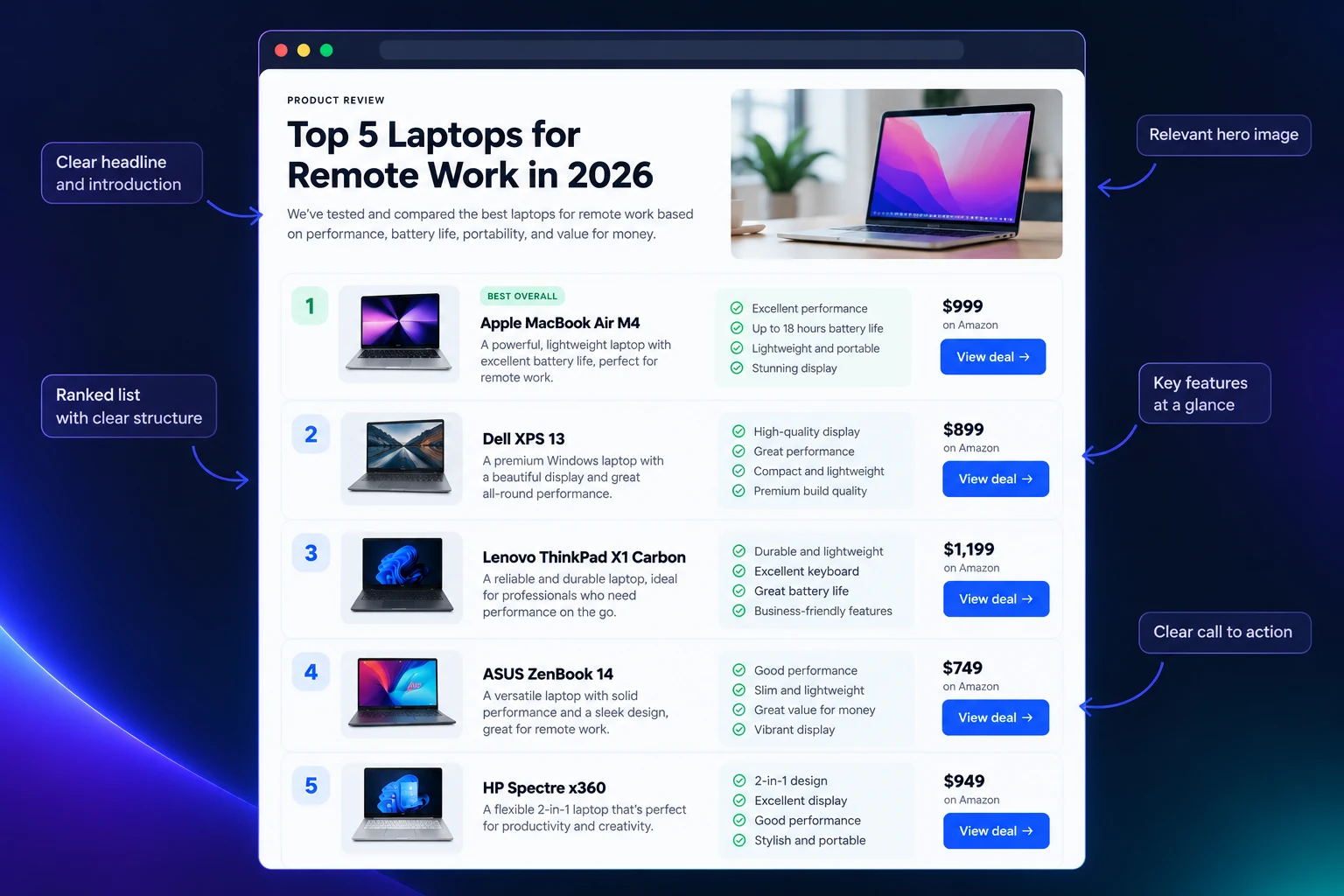
That last row matters more than people think. Because a listicle landing page is designed to look like content, you need a clear ad disclosure to stay compliant. The FTC's native advertising guide for businesses spells out when and how that disclosure needs to appear. How to Build a Listicle Landing Page
You can build a listicle landing page in any page builder, from Shopify apps to dedicated landing page tools. The build process comes down to five steps. 1. Pick a Product-Relevant Angle
Start with the angle, not the design. '5 Reasons Runners Over 40 Are Switching to This Shoe' is specific and curiosity-driven. A vague '5 Reasons to Buy Our Shoe' is not. The angle should tie directly to what the product actually does. 2. Write the List
Aim for five to seven points. Each one should handle a single benefit or objection, and you should lead with your strongest point since attention fades as people scroll. Keep paragraphs short and skimmable. 3. Add Proof and a Comparison
Drop in reviews, ratings, or before-and-after visuals to support your claims. A short comparison against the obvious alternative, whether that's a competitor or 'doing nothing,' gives fence-sitters a reason to act. 4. Place Your CTAs
Repeat the call to action at the top, somewhere in the middle, and at the bottom. A reader who's convinced by point two shouldn't have to scroll to the end to find the button. 5. Decide Where the Click Goes Next
This is where most people stop thinking, and it's the most important part. A listicle landing page is rarely the final step. It usually passes traffic to a second lander or straight to the offer. How you connect those pages determines whether you can actually track what's working, which brings us to the part most guides skip. Listicle Landing Page Examples and Common Angles
Rather than copy a specific brand's page, it's more useful to learn the angles that repeatedly convert. A few listicle landing page examples you'll see across native and ecommerce traffic: - The 'X reasons' list. '7 Reasons This Cookware Is Selling Out' uses curiosity and scarcity to pull cold readers in.
- The problem-solution list. Each point names a frustration ('tired of chipped pans?') and positions the product as the fix.
- The comparison list. '5 Things Melatonin Won't Do (That This Spray Will)' frames the product against a familiar alternative.
- The segment-specific list. '5 Skincare Tips for Mature Skin' speaks to one audience, which lifts relevance and conversion rate.
These angles work because they lead with value. The sell is there, but it arrives after the reader has already gotten something useful. Listicle vs Advertorial: What's the Difference?
Since the two terms come up together constantly, here's the quick distinction. An advertorial is any ad written to look like editorial content, and it can take any shape, including a straight narrative story. A listicle is a specific format of advertorial that organizes the persuasion into a numbered list. In other words, every listicle landing page is an advertorial, but not every advertorial is a listicle. Media buyers often test both formats against the same offer to see which angle their traffic responds to. How to Track a Listicle Landing Page in ClickFlare
Here's the catch with a listicle funnel: it has more steps than a standard campaign. Traffic goes from the ad, to a pre-lander (your listicle page), to one of several landers, and finally to an offer. Each extra hop is a place where attribution can break if you're not tracking it properly. ClickFlare has a dedicated Listicle path type built for exactly this funnel. It's the only campaign flow in ClickFlare that supports a pre-lander, and it lets you tie every click from the listicle down to the specific lander and offer it sent traffic to. Here's how the setup works. 1. Create the Pre-Lander
In ClickFlare, open Landers from the left menu and click +New. Enter the name and URL, set the Number of CTAs, then turn on the 'Use as prelander' toggle at the bottom. The number of CTAs sets how many landers you can connect, so a pre-lander with three CTAs links to three landers. ClickFlare generates a Click URL for the page automatically, so copy it for reference before you save. One thing to get right the first time: landers and pre-landers can't be converted to one another after creation. 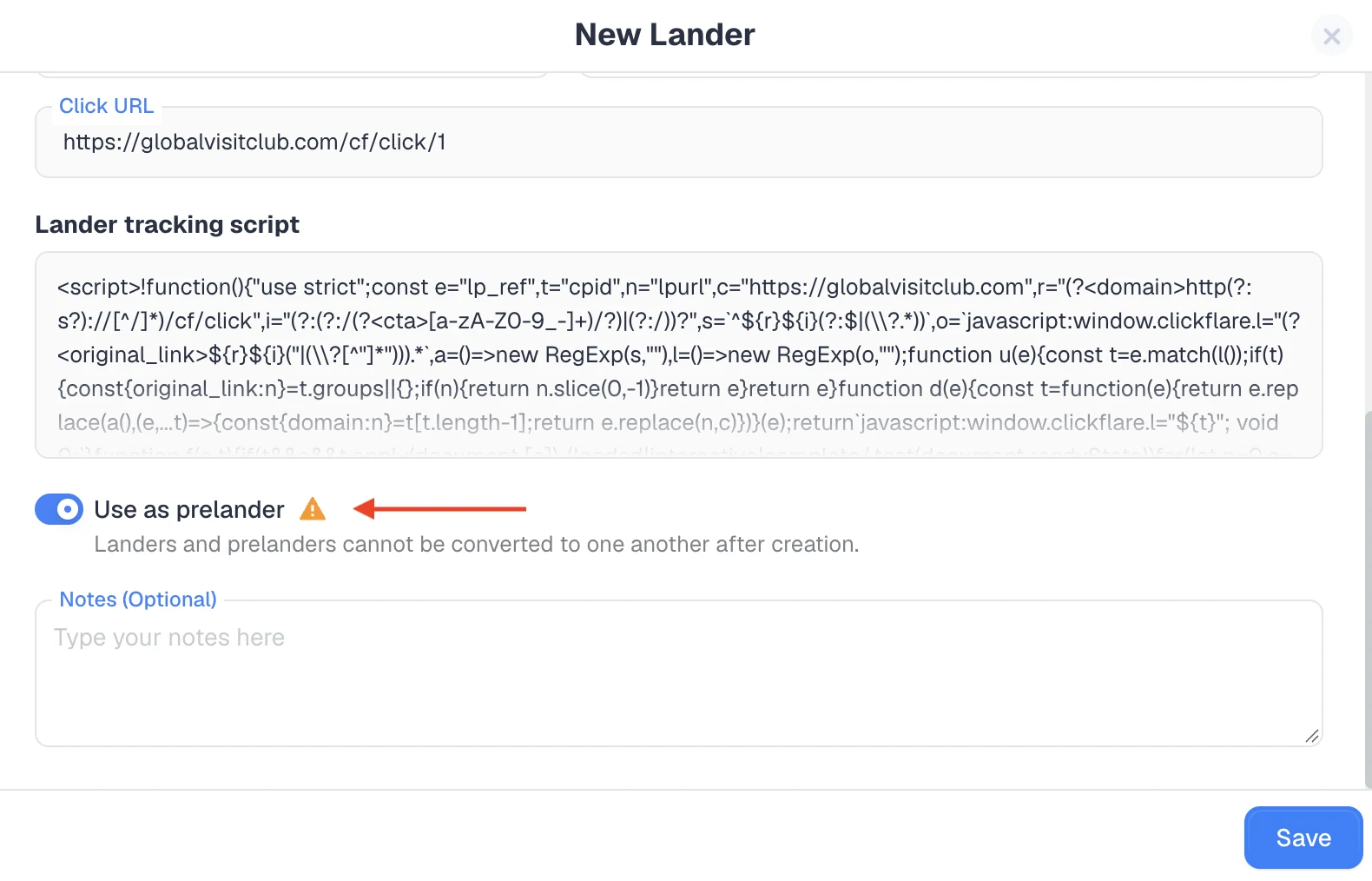
2. Add Your Landers and Offers
Create one lander for each CTA on the pre-lander, the same way you built the pre-lander but with the 'Use as prelander' toggle left off. Each lander links to a single, unique offer. ClickFlare keeps this strictly one-to-one: a lander can't be reused across pairs, and an offer can only be linked from one lander. A single listicle supports up to 20 landers, and a visitor can pass through at most two landers on the way to the offer. 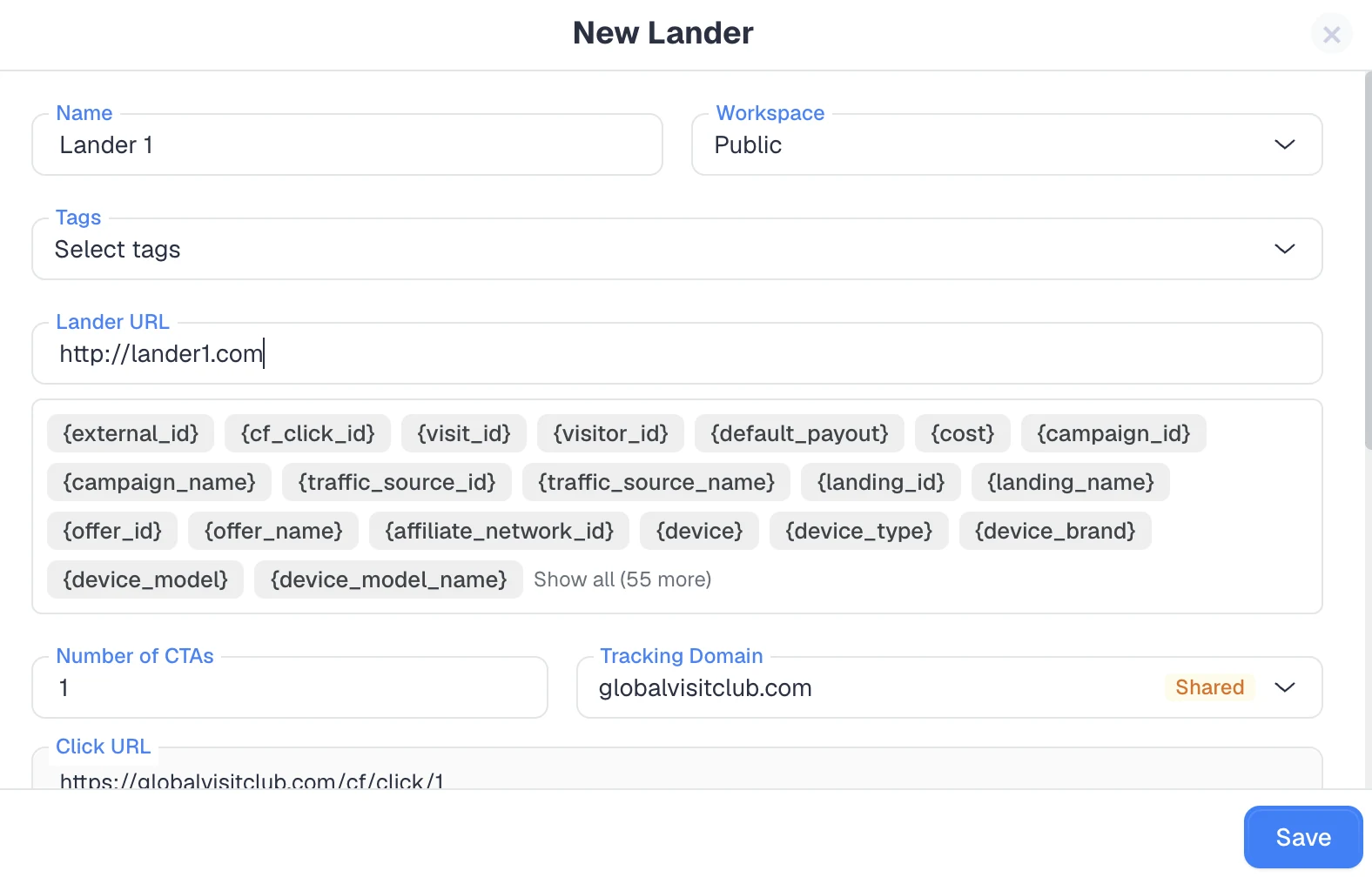
3. Build the Listicle Campaign
Create a new campaign and choose your traffic source and cost model. In the Paths section, set the Path Destination to Listicle, then build the funnel: pick your pre-lander, and pair each lander with a single offer so Lander 1 points to Offer 1, Lander 2 to Offer 2, and so on. Save once the funnel is mapped. Leave Transition to offer on the default 302 redirect unless you have a specific reason to change it. The 302 routes each click through ClickFlare so every step is tracked, while the Direct option skips that redirect and gives up the attribution in between. 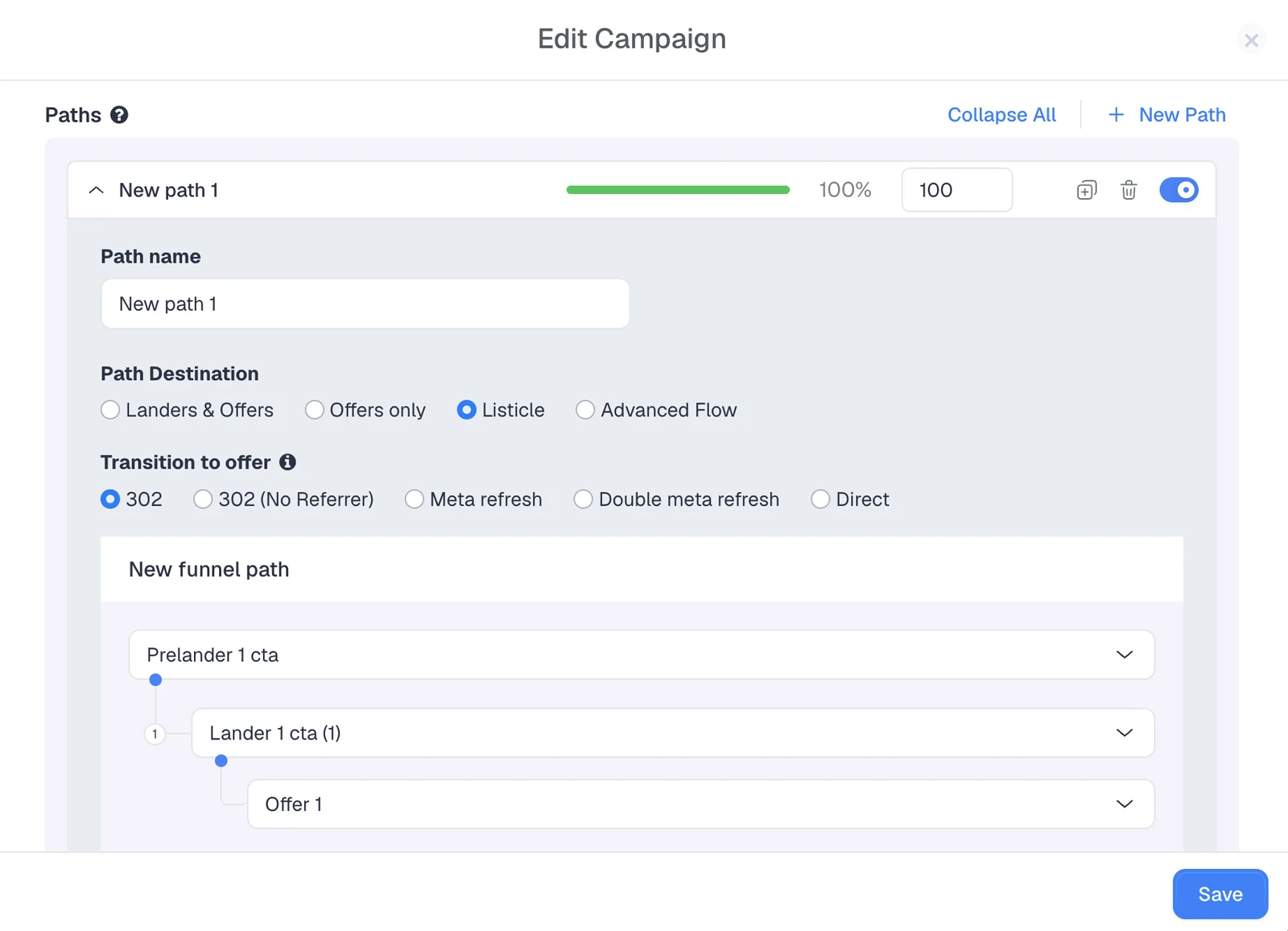
4. Place Your Tracking URLs
A listicle campaign generates three types of URL. Getting each one in the right place is what makes the whole funnel track correctly. | URL Type | Where It Goes |
| Campaign URL | In your ad. It sends traffic to the pre-lander (your listicle page). |
| Intermediate click URL | In the pre-lander's body, one per lander. These are the listicle's CTA links. |
| Classic click URL | In each lander's body. This sends the visitor from the lander to the offer. |
One easy-to-miss step: add the ClickFlare lander script to the pre-lander, not just the landers. The pre-lander is the first page visitors reach after the ad, so without the script on it, the journey may not track correctly from the start. For the exact placement details, ClickFlare's own docs on listicle landing page setup walk through editing the body of each page link by link. If your funnel is simpler and you're sending traffic straight to a single offer instead, our guide on what direct linking is covers that setup. Listicle funnels are also a core tactic in native and search arbitrage, which we break down in our native to search arbitrage guide. Common Mistakes to Avoid
- Skipping the lander script on the pre-lander. This is the single most common listicle tracking error. No script on the first page means broken attribution for the whole funnel.
- Reusing a lander or offer across pairs. ClickFlare's listicle flow expects a clean one-to-one mapping. Reusing pages breaks the reporting logic.
- Forgetting the ad disclosure. A page that looks like editorial needs a clear 'advertisement' label to stay compliant.
- Burying the CTA. If your only call to action sits at the very bottom, you lose every reader who was sold halfway down.
- Not matching the ad to the page. If your ad promises '5 reasons' and the page opens with something else, bounce rates spike.
Final Thoughts on Listicle Landing Pages
A listicle landing page earns its reputation because it respects how people actually read: they scan, they skip, and they resist a hard sell. Build one around a specific angle, lead with your strongest points, and repeat the CTA, and you've got a funnel that warms cold traffic without scaring it off. The piece most marketers skip is tracking, and that's where a multi-step listicle funnel either proves its worth or leaves you guessing. Set it up as a proper Listicle path in ClickFlare, place all three URL types correctly, and you'll know exactly which page and which angle is driving your conversions. Frequently Asked Questions
What Is a Listicle Landing Page?
A listicle landing page is a landing page written in a numbered list format, like '5 reasons to buy X.' It blends the educational feel of a blog post with a sales page's conversion focus, making it a strong destination for cold ad traffic. Are Listicle Landing Pages and Advertorials the Same Thing?
Not quite. An advertorial is any ad written to look like editorial content. A listicle is one specific format of advertorial that organizes the message into a numbered list. Every listicle is an advertorial, but not every advertorial is a listicle. How Many Items Should a Listicle Landing Page Have?
Five to seven points works well for most offers. That's enough to handle your main benefits and objections without overwhelming the reader. Always lead with your strongest point, since attention drops the further someone scrolls. How Do You Track a Listicle Landing Page?
Use a tracker with a dedicated listicle flow, like ClickFlare. It links the pre-lander to multiple landers and offers, then generates the click URLs you place on each page so every step of the funnel is attributed back to the right campaign. How Many Landers Can a ClickFlare Listicle Support?
A single ClickFlare listicle supports up to 20 landers, each linked to one unique offer. A visitor can pass through a maximum of two landers before reaching the offer, and offer rotation within a listicle is not supported. Need a hand with listicle tracking?
Try out ClickFlare for free and book a call with one of our tracking specialists who will walk you through setting up your listicle funnel end to end.
TRY CLICKFLARE FREE FOR 14 DAYS →